Specs and overview
We've been claiming it for years, the SATA II controller is/was a bottleneck for future generation SSDs as they were literally hitting the upper ceiling in terms of performance. We've now reached that threshold. With the slow move towards SATA III, effectively the bandwidth your storage device can work in has doubled up, and believe it or not... that's great but still not enough for the years to come as SSD performance over the coming year or two will take an even larger leap in peak performance.
We have stated it many times and explained this quite a bit, but the seek time on SSD drives is insane; nothing short of amazing, at less than 1ms -- 0.1ms as we can actually measure. The average seek time for a traditional HDD is roughly 9ms. Do the math, hey, no more moving and spinning mechanical components is the key here.
The traditional HDD is a limiting factor in the overall PC experience. Also, storage performance like this will, for example, greatly enhance load times of Photoshop, generic applications, Office, game load times and even simple stuff like browsing the web will become a much faster experience.
But let's move onwards to the SSD itself.
Specifications and architecture
Here's where we'll look a little deeper inside the actual product. The Intel 510 series is, as stated, an SSD based on MLC NAND flash memory. The difference though is that it uses that new SATA III interface. The end result here is that you'll get a storage unit with great IO performance, peaking up-to 315 MB/sec in read performance and a cool 470 MB/sec write performance.
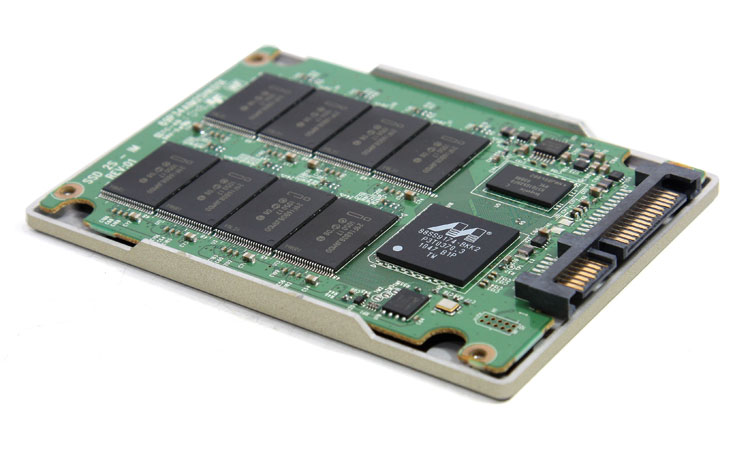
When we opened up the SSD, we were a little shocked, Intel did not use a proprietary Intel controller, yet rather opted to use the Marvell 9174 SATA 3 controller soldered to the SSD circuit board (PCB). The Marvell 9174 is the same controller Micron uses in its C400, and the same controller in Corsairs Performance Series 3 SSDs.
The SSD is available in two volume sizes: 120, and 250 GB are available. The products range from roughly 280 USD towards 580 USD for this 250GB version. Intel covers the unit with a 3 year warranty. Some key features:
| Brand | Intel |
| Type | 510 |
| Capacity | 250GB |
| Cache | 128MB |
| SSD-type | Multi Level Cell |
| SSD-controller | Marvell 88SS9174 |
| Trim | Yes |
| BUS Interface | SATA-600 |
| Size | 2.5" |
| Height | 9,5mm |
| SDD READ | 470MB/s |
| SDD WRITE | 315MB/s |
| Warranty | 3 years carry in |
The controller itself is paired with cache memory to tackle an old SSD problem, dealing with many small files. As such you'll find a 128MB Hynix DDR3-1333 SDRAM IC on the PCB. NAND FLASH wise 510 was equipped with preferred 34nm Intel NAND rated at 5,000 p/e cycles. Intel might be switching towards 25ns as well, we don't know this for sure.
To understand the product we'll need to realize that there are primary technologies embedded into the storage unit. As such we'll continue the technology coverage in two stages:
- The SSD partitions paired with the controller
- SATA III 6 Gbit interface
We'll explain each one in a simple manner. Next page please.