Page 2
Right, let's start up with some power supply 101 remarks ,but first let's answer you why a PSU is so darn important. Here's the deal: A PSU feeds each and every component in your PC with a good amount of current. A PSU needs to manage the power demand in a very secure way, otherwise it'll create instability throughout the system. That instability can result as crashes, freezes, underperforming software such as games that run poorly when the graphics card isn't fed enough power, and even resets or shuts down the system completely. Please do not underestimate the importance of the PSU!
Why do I say this? Guru3D users often have heft gaming rigs with the hottest components. A modern high-end rig (which we'll use to test this PSU today) can utilize a 400-500 Watts power consumption pretty easily. Now you can see why these little old grey 300 Watt PSU's we had 3 years ago are by far not sufficient anymore. Today for example, with two GeForce 8800 cards in SLI, Core 2 Duo overclocked and 2 GB memory we'll peak at 500 watts already.
Two years ago another trend picked up which we did not foresee. We, the consumers, all created a demand for modified PCs. The dull beige painted PCs had to go. We want nicely shaped cooled and preferably lit PCs with side windows so we could actually look at the inside of the PC. Really cool to look at but that created another issue. We now had the beautiful looking cases where you could look inside, but that resulted in pulling the hairs out of your head as there were yellow, red, and black wires coming from the PSU everywhere.
So the power supply received a new function; aesthetics. It needs to look nice. By organizing cables and by giving you the option to actually modify the wires you want to use, another problem was solved. We call it cable management these days. Something the PSU we test today also has.
The two reasons mentioned above from a consumer point of view have been by far the most important development for PSUs. Namely stable high output quality power distribution and the option for modability, using only the wires that you need. Almost EVERY manufacturer has picked up on this trend and it has become a very big market for sure.
But yet another factor rises that we now need to weigh in. Sound levels coming from your PSU. The high rated PSU's typically have two fans and a lot of manufacturers did not pay attention to all the noise a PC makes these days. So the third factor was utilizing silent high-performance fans preferably with smart-fan technology (variable fan speeds based on heat).
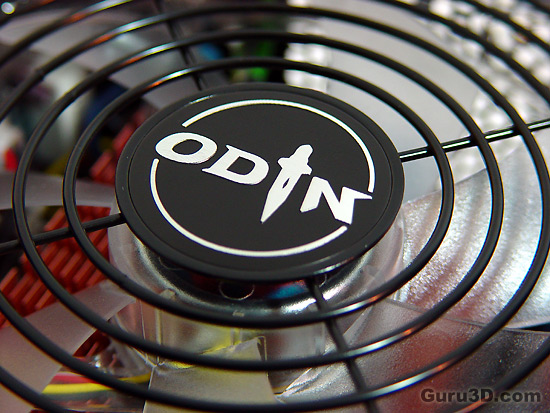
And with these factors in mind we land at a product line called Odin GT, we do not expect this product to make heaps of sound. The product comes from the oddly sounding "Odin" range. We'll be testing the 800 Watt model to see if it can manage a high-end system with NVIDIA SLI technology.
You will notice that all supplied connectors are nicely wrapped in a black colored foil/plastic and are detachable. It is looking good for sure. It's advanced cable management that facilitates the installation and gives you the option to only use the required cables.
The Odin GT is an 800 Watt PSU which places it in the high-end segment. A PSU which (although not certified) is ready for SLI ready and Crossfire; as it has four 12 volts PCI-Express connectors which combined can carry a total of 62 AMPs, and according to the box, the PSU 12 volts V3 and V4 rails may peak to 25 AMPs per 12V rail. Which I find interesting as no European regulated power socket can utilize.
Next to that we find active PFC and smart fan technology. And a highly efficient power consumption. We'll chat about that in a minute though.
| AC INPUT | 100-240 Vac 10/5A 47-63Hz | |||||||
| DC OUTPUT | +3.3V | +5V | +12V1 | +12V2 | +12V3 | +12V4 | -12V | +5Vsb |
| MAX OUTPUT CURRENT | 30A | 28A | 18A | 18A | 25A | 25A | 0.8A | 3.0A |
| 62A | ||||||||
| MAX COMBINED WATTAGE | 180W | 744W | 9.6W | 15W | ||||
| 780W | 20W | |||||||
| TOTAL POWER | 800W | |||||||
The PSU is is compatible with EPS12V v2.9, ATX12V v2.2, thus can handle all of your power needs. It can handle a power draw of 28A on the 5v and 30A on the 3.3v rails. Next to that it the four 12v rails can be used to power your graphics cards and come with the new 6/8 pin connector design (PCI-E II connectors), combined you'll see 800 watts of pure rocking powah.