Guru3D.com
  • HOME
  • NEWS
    • Channels
    • Archive
    • Search
    • Submit
  • DOWNLOADS
    • New Downloads
    • Categories
    • Archive
    • Search
    • Submit
  • GAME REVIEWS
  • ARTICLES
    • Editorials
    • Guru3D VGA Charts
    • Rig of the Month
    • Join ROTM
    • PC Buyers Guide
    • Dated content
    • More Categories
  • HARDWARE REVIEWS
    • Videocards
    • Processors
    • Audio
    • Motherboards
    • Memory and Flash
    • SSD Storage
    • Chassis
    • Power Supply
    • Laptop and Mobile
    • Smartphone
    • Networking
    • Keyboard Mouse
    • Cooling
    • Knowledgebase
    • Search articles
    • More Categories
  • FORUMS
  • SEARCH
    • Search Articles
    • Search News
    • Search Files
  • NEWSLETTER
  • CONTACT

New Reviews
ASUS Maximus VI Extreme Z87 motherboard review
ASUS GeForce GTX 780 DirectCU II OC review
Fractal Design Arc Midi R2 review
Corsair Vengeance K70 review
MSI GeForce GTX 770 Lightning review
EVGA GeForce GTX 770 SC review
Plextor M5M 256GB mSATA SSD review
AMD A10 6800K review
SanDisk Extreme II 120 - 240 and 480 GB SSD review
ASUS Sabertooth Z87 motherboard review

New Downloads
Media Player Classic Home Cinema v1.6.8 Download
Sandra 2013 SP4 19.50 download
MSI Afterburner 3.0.0 Beta 10 Download
AMD Catalyst 13.6 BETA 2 Download
CPU-Z 1.6.4
AIDA64 Download version 3.00
AMD Catalyst 13.6 BETA Download
PrecisionX Download Version 4.2.0
GeForce 320.18 WHQL Driver Download
AMD Catalyst Application Profile Download 13.5 CAP1


New Forum Topics
by: cjs007 The Last of Usby: J.B.west Help me choose music for my gfs restaurantby: harkinsteven Xbox One at E3 all PC's?by: blesner Give Away Threadby: Lemonking Will the 770 work properly in my setup?by: John Guru3D Music Discussion Threadby: Stone Gargoyle Xbox World reveals Next Gen Xbox?by: Pill Monster Win ToolKit - anyone used i? It's an amazing tool to used to image your OS before insby: Taint3dBulge AMD FX 9590 to cost $960by: rizqicandra amd catalyst stopped working (need help urgently)


Online Users
There are currently 2032 user(s) online:
Google, mameira, MSN, tomsanity, xIcarus, Yahoo


Guru3D.com » Review » Gigabyte GeForce GTX 680 OC edition review » Page 5

Gigabyte GeForce GTX 680 OC edition review - The graphics architecture that is Kepler

Posted by Hilbert Hagedoorn on: 04/08/2012 01:00 PM [ 0 comment(s) ]

Tweet


The graphics architecture that is Kepler

As you can understand, the massive memory partitions, bus-width and combination of GDDR5 memory (quad data rate) allow the GPU to work with a very high framebuffer bandwidth (effective). Let's again put most of the data in a chart to get an idea and better overview of changes:

Graphics card GeForce GTX 480 GeForce GTX 580 GeForce GTX 680
Fabrication node 40nm 40nm 28nm
Shader processors 480 512 1536
Streaming Multiprocessors (SM) 15 16 8
Texture Units 60 64 128
ROP units 48 48 32
Graphics Clock (Core) 700 MHz 772 MHz 1006/1058 MHz
Shader Processor Clock 1401 MHz 1544 MHz 1006/1058 MHz
Memory Clock / Data rate 924 MHz / 3696 MHz 1000 MHz / 4000 MHz 1502 MHz / 6008 MHz
Graphics memory 1536 MB 1536 MB 2048 MB
Memory interface 384-bit 384-bit 256-bit
Memory bandwidth 177 GB/s 192 GB/s 192 GB/s
Power connectors 1x6-pin PEG, 1x8-pin PEG 1x6-pin PEG, 1x8-pin PEG  2x6-pin PEG
Max board power (TDP) 250 Watts 244 Watts 170 Watts
Recommended Power supply 600 Watts 600 Watts 550 Watts
GPU Thermal Threshold 105 degrees C 97 degrees C 98 degrees C

So we talked about the core clocks, specifications and memory partitions. Obviously there's a lot more to talk through.

To understand a graphics processor you simply need to break it down into pieces to better understand it.  Let's first look at the raw data that most of you can understand and grasp. This bit will be about the Kepler architecture, if you're not interested in g33k talk by all means please browse to the next page.
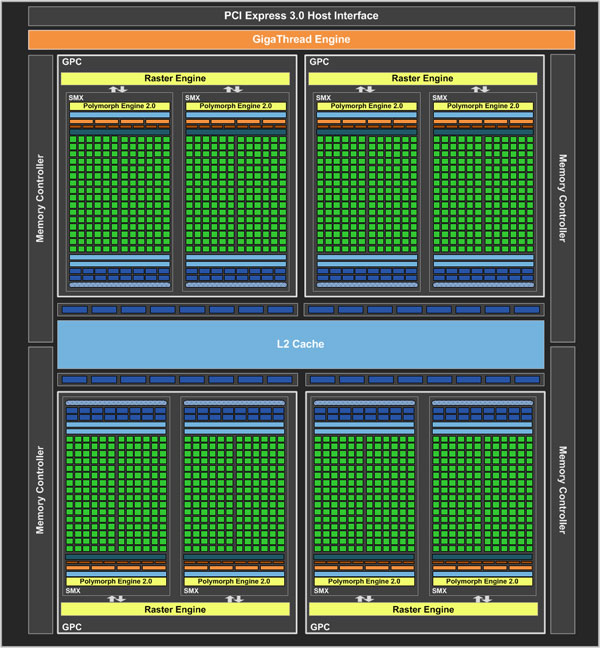
GeForce GTX 680

So above we see the GK104 block diagram that entails the Kepler architecture. Let's break it down into bits and pieces. The GK104 will have:

  • 1536 CUDA processors (Shader cores)
  • 192 CUDA core clusters (SM).
  • 8 geometry units
  • 4 raster Units
  • 128 Texture Units
  • 32 ROP engines
  • 256-bit GDDR5 memory bus
  • DirectX 11.1

The more important thing to focus on are the SM (block of shader processors) clusters (or SMX as NVIDIA likes to call it for the GTX 680, which  has 192 Shader processors. That's radically different from Fermi, the GeForce GTX 580 for example had 32 shader processors per SM cluster. 1536 : 192 = 8 Shader clusters (SMs). Let's blow up one such cluster:
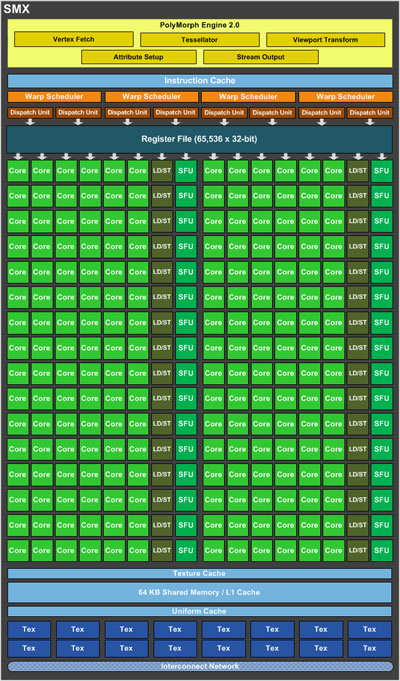
GeForce GTX 680

Above the block diagram for a single Shader processor cluster, aka SM or SMX as NVIDIA now calls it. The new SMX has quite a bit more bite in terms of shader, texture and geometry processing. 192 CUDA cores, that's six times the number of cores per SM opposed to Fermi. Now, at the end of the pipeline we run into the ROP (Raster Operation) engine and the GTX 680 again has 32 engines for features like pixel blending and AA.

There's a total of 128 texture filtering units available for the GeForce GTX 680. The math is simple here, each SM has 16 texture units tied to it.

  • GeForce GTX 580 has 16 SMs X 4 Texture units = 64
  • GeForce GTX 680 has 8 SMs X 16 Texture units = 128

Above the GK104 host interface - The Gigathread engine, four GPCs, four memory controllers, the ROP partitions, a 768 KB L2 cache. Each GPC has eight polymorph engines - ROP partitions are nearby to the L2 cache, Each shader cluster then is tied to L1 and a shared L2 cache. Shading performance is going be increased quite bit, geometry performance will get a nice boost as well.

NVIDIA is using 64KB Shared Memory/L1 per SMX – please note that they have a 16/48 – 48/16 ratio here for graphics/compute, as before with Fermi. For L2, 128KB per 64-bit memory controller. So that adds up to 512KB L2

In regards to architectural changes, on top of the pipeline NVIDIA has now added new Polymorph 2.0 (world space processing) engines and raster (screen space processing) engines, they act like a mini CPU really.


26 pages « < 4 5 6 7 next »


Related Articles
Gigabyte G1 Sniper 5 motherboard review
In this review we test and benchmark the Gigabyte.G1 Sniper 5 motherboard. This Z87 gaming themed mainboard is seated in the high-end range of Gigabyte's multiple Z87 motherboards releases. Pop on an Intel 22nm Haswell processor and you will notice that the G1.Sniper 5 is extremely feature rich and has great overclock potential. Oh and of course you'lll spot the black/green color schema again.Have a look at this 19 page this review.

Gigabyte GeForce GTX 770 WindForce 3x OC review
In this review we take the Gigabyte GeForce GTX 770 WindForce 3x OC for a spin. This model graphics card comes with a factory overclock and the new WindForce 3X 2 cooler with Triangle Cool fans. That would be three silent 80mm fans. Overall the card is sitting in-between the GeForce GTX 680 and GeForce GTX 780 , 100% cool and 100% silent. We test the product with the hottest games like Metro: Last light, Battlefield 3, Sleeping Dogs, Far Cry 3, Medal of Honor Warfighter, Hitman Absolution and many more.

Gigabyte Radeon HD 7790 2GB OC review
We test and review the Gigabyte Radeon HD 7790 2GB OC edition, also known under SKU code GV-R7790OC-2GD. We benchmark the product incl FCAT Frametimes. The new graphics card is intended to boost a little more performance into entry-level gaming. The Gigabyte HD7790 OC 2GB clocks in at 1075 MHz on the boost engine, packed with totally silent custom cooling.

Gigabyte GeForce GTX 780 WindForce 3x OC review
We test and review the Gigabyte GeForce GTX 780 WindForce 3x OC edition. The graphics card comes witha factory overclock and the new WindForce 3X 2 Slot 450W fan sink with Triangle Cool fans, as they like to cool it. That would be three silent 80mm fans. Overall the card is almost as fast as a GeForce GTX Titan, 100% cool and 100% silent. We test the product with the hottest games like Metro: Last light, Battlefield 3, Sleeping Dogs, Far Cry 3, Medal of Honor Warfighter, Hitman Absolution and many more.

Follow Guru3D on Google+ - Facebook - YouTube - Twitter © 2013