
Guru3D.com
  • HOME
  • NEWS
    • Channels
    • Archive
    • Search
    • Submit
  • DOWNLOADS
    • New Downloads
    • Categories
    • Archive
    • Search
    • Submit
  • GAME REVIEWS
  • ARTICLES
    • Editorials
    • Guru3D VGA Charts
    • Rig of the Month
    • Join ROTM
    • PC Buyers Guide
    • Dated content
    • More Categories
  • HARDWARE REVIEWS
    • Videocards
    • Processors
    • Audio
    • Motherboards
    • Memory and Flash
    • SSD Storage
    • Chassis
    • Power Supply
    • Laptop and Mobile
    • Smartphone
    • Networking
    • Keyboard Mouse
    • Cooling
    • Knowledgebase
    • Search articles
    • More Categories
  • FORUMS
  • SEARCH
    • Search Articles
    • Search News
    • Search Files
  • NEWSLETTER
  • CONTACT

New Reviews
MSI GeForce GTX 770 Gaming review
ASUS Maximus VI Extreme Z87 motherboard review
ASUS GeForce GTX 780 DirectCU II OC review
Fractal Design Arc Midi R2 review
Corsair Vengeance K70 review
MSI GeForce GTX 770 Lightning review
EVGA GeForce GTX 770 SC review
Plextor M5M 256GB mSATA SSD review
AMD A10 6800K review
SanDisk Extreme II 120 - 240 and 480 GB SSD review

New Downloads
Media Player Classic Home Cinema v1.6.8 Download
Sandra 2013 SP4 19.50 download
MSI Afterburner 3.0.0 Beta 10 Download
AMD Catalyst 13.6 BETA 2 Download
CPU-Z 1.6.4
AIDA64 Download version 3.00
AMD Catalyst 13.6 BETA Download
PrecisionX Download Version 4.2.0
GeForce 320.18 WHQL Driver Download
AMD Catalyst Application Profile Download 13.5 CAP1


New Forum Topics
by: aircool Battlefield 3 (Official Thread) Pt. 3by: NoviceRei Microsoft Fully Reverses Xbox One’s DRM Policiesby: Brasky XBOX One Policy Reversalby: bishi Geforce GTX 780 Owners Clubby: stasio Nvidia GeForce 320.18 WHQL Download and Discussionby: Supernoob2286 After a delid temps are horrible 95c!by: Pav 320.11 GTX780 Only Driverby: Andrew Neilson Just a warnign for you guys, RoC Xonar phoebus card DO NOT BUYby: sykozis Unstable...by: stasio Nvidia Quadro Driver 320.27 WHQL


Online Users
There are currently 2604 user(s) online:
cole2109, DiceAir, elkosith, elpsychodiablo, Google, Gripen90, iCroW, jkoppenhaver, Live Search, MSN, signex, spajdrik, vukk, Yahoo, yasamoka, zipper


Guru3D.com » Review » Core i5 2500K and Core i7 2600K review » Page 1

Core i5 2500K and Core i7 2600K review - Introduction

Posted by Hilbert Hagedoorn on: 01/02/2011 02:00 PM [ 0 comment(s) ]

Tweet


Intel Core i5 2500K and Core i7 2600K

Hey all and welcome to the new year! We've mentioned in some other reviews that 2011 is going to be a very significant year in the processor industry as we'll be faced with two changes. The first being a new architecture for both Intel and AMD, changes will allow processors to be faster "per core", something we have been evangelizing for a long time now. See, you can add more and more cores, in the consumer market we've gone from 1 towards 2 to 4 to 6 CPU cores and will go to 8, even up-to 12 cores in the next year or so. But software anno 2011 will take the best advantage of 2 to 4 CPU cores really, once you pass four CPU cores only professional applications and content transcode software remain a real benefit for that amount of multiple cores.

With that statement in mind, I'll take faster per core performance anytime when I'd have to choose in-between faster performing per core 4 or say 6-core processors. Exactly here is where today's tested processor is going to startle you.

The second major change you will see this year is to be found inside the processor as we'll start seeing integrated graphics processor cores, embedded and harbored into the processor. Last year, exactly a year ago to be precise, we already familiarized ourselves with the new Core i5 650, 660 and 661 processors. These CPUs already have GPUs inside of them, with one difference, they had two little small chips on the processor die, literally. And that's about to change.

Today of course we'll be reviewing Intel's latest architecture, developed under family codename Sandy Bridge. Intel today officially announced the Core i5 2500 and Core i7 2600 processors. Actually, they release four processors as the models tested are specific K edition (2500K & 2600K), the K is the indicator for unlocked multiplier processors.

Why K versions you ask? Well, the default Sandy Bridge processors will be much harder to overclock. With Nehalem (last generation Core i3/i5/i7) you pretty much take your base clock of 133 MHz and apply say a default multiplier of 25, that would be your 3.33 GHz processor. That base clock was capable of going so much higher, 150, 186 and when tweaked right, even over 200 MHz.

The new technology however has an embedded GPU / video processor merged into the very same processor die running over the same bus sharing the same L3 cache memory, things get increasingly complicated in matters of tweaking. The new 100 MHz baseclock of Sandy Bridge processors therefore is hard to tweak, if you are lucky you can get to 115 MHz, multiply that with your maximum multiplier and you'll notice that the default 2500/2600 processor can only overclock a few hundred MHz at best. And that is why Intel introduced the K series, it will offer you an unlocked multiplier which will allow you to go much, much higher.

With all the rumors on limited overclocking, the one thing that did surprise us was the overclock potential with these K series processors, but of course we'll show you a nice overclock session, and in fact all today's test benchmarks will carry overclocked test results with the 2600K processor running at 4300 MHz, on the stock Intel air cooler!

Enough of that for now though, today we'll put the Intel Core i7-2600K and Intel Core i5-2500K processors to the test, we will pair the 2600K processor with the Intel Desktop Motherboard DP67BG and also run a test with the Intel Core i5-2500K processor on an Intel DH67BL motherboard. Have a quick peek at the kit used below and then let's head onwards to the next page.
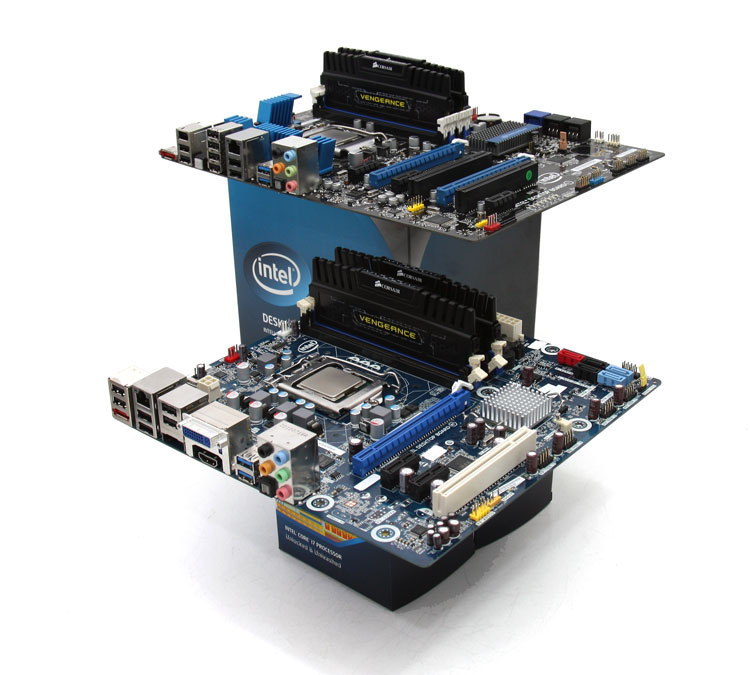
Intel Core i5 2500K and Core i7 2600K


23 pages 1 2 3 4 next »


Related Articles
Core i5 3570K processor review
We review the Core i5 3570K Ivy bridge processor. Will Ivy Bridge be the processor series everything you expected? Go find out in this extensive review here at Guru3D.

Core i5 2500K and Core i7 2600K review
Today we test and review Sandy Bridge, the Intel Core i7-2600K and Intel Core i5-2500K processors. We will pair the 2600K processor with the Intel Desktop Motherboard DP67BG and also run a test with the Intel Core i5-2500K processor on a Intel DH67BL motherboard

Core i5 655K and Core i7 875K processor review
Intel today releases two new processors targeted at a somewhat more enthusiast audience. Yes, processors for tweakers and overclockers. On socket LGA 1156 Intel now releases two K series processors. The 32nm Intel Core i5-655K processor has the very same specifications as the Core i5 650; it will operate at 3.2 GHz, will feature two cores with Hyper-Threading technology, sport 4MB of L3 cache and will be made using 32nm process technology. The difference between the 650 and 655K is the unlocked multiplier only. Then we have the enthusiast class Intel Core i7-875K processor, it has the very same specifications as the Core i7 870; it will operate at 2.93GHz, will feature four cores with Hyper-Threading technology, sport 8MB of L3 cache and will be made using 45nm process technology. The only difference between the two central processing units (CPUs) will be the unlocked multiplier on the 875K chip, which will allow overclockers and enthusiasts to easily boost clock-speed of the product without the necessity of overclocking other parts of their systems.

Core i5 650 - 660 and 661 processor review
The time has come for Intel to debut a new line of mainstream 32nm processors, which we have all learned to recognize under the codename 'Clarkdale', the new CPUs will be aimed at the mainstream desktop PC segment and will complement the chip maker's Core i3 and Core i5 line of products. The Intel processor lineup will include the Core i3 530 and 540 models, as well as the Core i5 650, 660, 661, and 670, which will be featured with Hyper-Threading, 4MB of L3 cache and support for dual-channel DDR3-1333 memory. Well, that and an integrated GPU as well of course. Guru3D will put the Core i5 650, 660 and 661 to the test.

Follow Guru3D on Google+ - Facebook - YouTube - Twitter © 2013