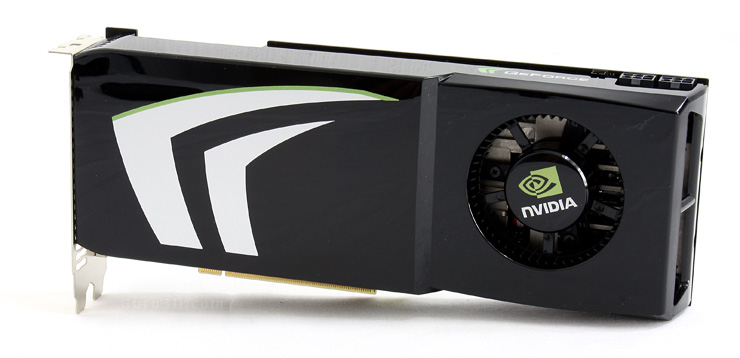
The GeForce GTX 275 GPU
The GeForce GTX 275 GPU
So I'd like to start off with a little 101 on the GTX 200 series GPU. The GTX 275 is all about the 55nm fabrication based product series GTX 200. The GTX series 200 GPU sums up to 1400 million transistors. It's the biggest beast of a graphics processor that NVIDIA has ever built with 1400 million transistors.
1400 million transistors, think of a transistor as an on/off switch on = 1 and off = 0.
Now imagine 1400 million transistors times the clock frequency of the GPU ( this determines how many times per second the transistors can change state, or, rather, switch between 1 and 0).
Then take a MHz, 1 MHz denotes one million hertz or one million cycles per second. I don't know what will drive you more nuts; thinking about the number of operations going on in a GPU0, or squeezing your left nut. Think about that for a minute you might go nuts.
GeForce GTX 260/275/285
- 1.4 billion transistors
- 993 GigaFLOP processing power
- 240 processing (shader) cores (GTX 275/285)
- 55nm node fabrication
- DirectX 10
- New power management enhancements
- CUDA parallel processing
- GeForce PhysX
How different is the GTX 275 to the GTX 285? A very valid question, the answer is: for you as an end user, not much. In fact, the very same GPU has been utilized bringing 240 stream processors to the GTX 275.
What is different though is that the GTX 275 obviously had to be a tad slower than big daddy GTX 285. Therefore NVIDIA gave it the GTX 260 memory configuration, 896 MB of gDDR3 memory over a 448-bit bus (opposed to 512bit). It gives the product a 127 GB/s bandwidth.
The new GeForce GTX 275 reference based product will run at a core clock frequency of 632 MHz. There are more clocked domains inside that GPU though, the shader processors run at 1404 MHz and the memory is at 1134 MHz (effectively 2268 MHz). And though that is a higher clock opposed to the previous GTX 280, it is slightly slower than a GTX 285. But really, it accounts for only a little performance differential.
| GeForce GTX 260 |
GeForce GTX 275 |
GeForce GTX 280 |
GeForce GTX 285 |
GeForce GTX 295 | |
| Stream (Shader) Processors | 192 | 240 | 240 | 240 | 240 x2 |
| Core Clock (MHz) | 576 | 632 | 602 | 648 | 576 |
| Shader Clock (MHz) | 1242 | 1404 | 1296 | 1476 | 1242 |
| Memory Clock (MHz) x2 | 999 | 1134 | 1053 | 1242 | 999 |
| Memory amount | 896 MB | 896 MB | 1024 MB | 1024 MB | 1792 MB |
| Memory Interface | 448-bit | 448-bit | 512-bit | 512-bit | 448-bit x2 |
| HDCP | Yes | Yes | Yes | Yes | Yes |
| Two Dual link DVI | Yes | Yes | Yes | Yes | Yes |
For the folks that like to go a little deeper: this high-end part has 896MB of GDDR3 memory which has a 448-bit memory bus that binds to seven 64-bit memory controllers inside the GPU.
When we follow that good old pixel pipeline we run into a ROP (Raster Operation) domain. The GTX 275 has 28 of them and 80 texture filtering units. Performance accounts up to roughly 1 TFLOP (depending how you measure it actually).
What's nice about the GTX 275 release is that it is based off the new 55nm fabrication process, this has several advantages. The new 55nm GTX series 200 GPUs require a little less voltage, as a result it consumes less power. You'll spot two 6-pin connectors on the boards, whereas the GTX 280 for example still had one 6-pin and one 8-pin connector for it's feed.
The TDP (peak wattage) is now roughly 219 Watts. The product got faster, yet consumes less power. Cast your mind back to the GeForce 8800 Ultra which used 235W (peak) where we now see cards perform at least twice as much with less power needed. Performance per Watt again has increased on many fronts, which is good as it's the green thing to do.
As stated the GTX 275 is fed by two six-pin connectors. Power consumption for this 10.5-inch board is ~219W.