A name change and intro to Lynnfield
Okay then! You made it to page two. Did you equip yourself with some coffee already? This will be a long and lengthy article.
Before we begin -- a new name change So with this launch you'll be hearing phrases like Core i3, Core i5 Core i7 and even Core i9. Some of you already know this. But several of you guys and gals will go 'huh?' Intel is attempting to simplify its Intel Core range of products, getting rid of confusing Core 2 Duo, Core 2 Quad and similar names in favor of simpler Core i3 and Core i5 designations joining the recently unveiled Core i7 chips.
It's very simple: Core i3 will be reserved for entry-level products, Core i5 for mid-range products and i7 for flagship offerings. And Core i9... well that remains to be discussed and to be announced.
Meet the new processors
Man, did we have to wait a long time for some new 'mainstream' more affordable yet spicy processors to arrive in the Intel processor arena. So hear me out, for this launch there will be three models released, all are quad-core processors and based on the new Lynnfield core (a separate SKU based off Intel's Nehalem family processor architecture) you've been hearing about for so long now, using the 45 nm fabrication process.
Intel is announcing three processors today:
- Core i5 750 [2.66 GHz] 199 USD
- Core i7 860 [2.80 GHz] 285 USD
- Core i7 870 [2.93 GHz] 555 USD
Some key features:
- Four x86 processing cores with support for HyperThreading technology
- Dual-channel DDR3 memory controller specified to run DDR3-1066 and DDR3-1333 modules
- Support for TurboBoost technology.
- 32 KB instruction + 32 KB data L1 cache per core
- 256 KB L2 cache per core
- Large 8 MB L3 cache shared by all 4 cores
Three new processors, all are Nehalem architecture based, all have a new LGA 1156 socket design and all have the same Core i7 caches, the biggest phat one being a L3 cache of 8MB. All three LGA 1156 processors fall under codename Lynnfield, with Nehalem as the family designation. Intel will begin shipping the Core i5 750, Core i7 860 and Core i7 870 starting this week, with quad core clock-speeds of 2.66GHz, 2.8GHz and 2.93GHz. The three chips are to be priced at $199, $285 and $555 respectively.
Later on in early 2010 we'll see two energy saving versions of the Core i5 750s and Core i7 860s, running at 2.4GHz and 2.53GHz, but with 82W TDP rather than 95W.
Once we insert all the data into a chart, we can understand the product differentiation a little better:
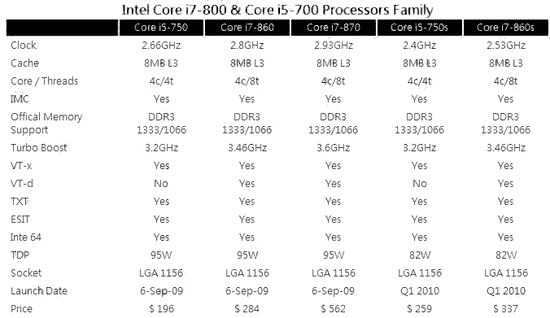
What are the differences between Bloomfield based Core i7 processors and Lynnfield based Core i7 processors? Three things really, dual-channel memory support (not triple-channel), a new socket (1156) and multipliers are locked. So yes, from that perspective Lynnfield processors are definitely a small step back. But don't get scared just yet though, they are seriously fast.
Then you notice the new Lynnfield processor designated Core i5. What's the biggest difference in-between Core i7 and Core i5 you might ask? The Core i5 CPUs are physically the same as the Core i7 Lynnfield parts, yet are further limited. The Core i5 700 range will have the same 8MB L3 cache, VT-x virtual machines and LGA 1156 socket support as the Core i7, but lack the Hyper Threading technology that allows the Core i7 processors to effectively double their core-count to eight. The Core i5 750 is limited to dual-channel memory as well.
- Core i5 750 maximum multiplier 20x133 = 2.66 GHz
- Core i7 860 maximum multiplier 21x133 = 2.80 GHz
- Core i7 870 maximum multiplier 22x133 = 2.93 GHz
So the more important differences are threefold, Lynnfield Nehalem processors are not classified as Extreme editions, and thus the multiplier will be locked, the 800 range will have Hyper Threading, the 700 series will not. Dual-channel memory instead of triple-channel memory and thus that new Socket change from LGA 1366 to LGA 1156.
There is an improvement to be found in Lynnfield's Turbo mode though. Let's go check it out.
KITT -- engage Turbo mode
Core i5 and Core i7 processors have something that is called 'Turbo mode'. Depending on CPU load one or more CPU cores will run above its advertised specification...
Much like the initial Turbo mode introduced for Core i7, the new Lynnfield processors have Turbo mode as well. It changed a little as there are several (five) steps in which the Turbo mode will be utilized.
Very simple: if one CPU thread is used only one processor core will automatically overclock in this order, Core i5 750 to 3.2GHz, the i7 860 to 3.46GHz and the i7 870 to an amazing 3.60GHz.
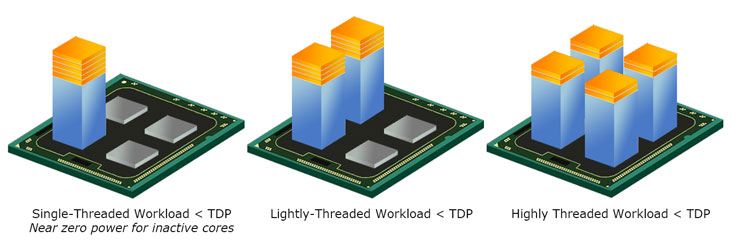
However look at the following image, if two threads are used on two cores, the Core i7 870 for example will then clock both cores at 3.4 GHz. And if there is massive CPU utilization on all four CPU cores, Turbo mode will still kick in at 3200 MHz (for the Core i7 870) on all active CPU cores.
So as you can see, Turbo mode now works in several configurations depending on load and multi-threaded applications. We like it very much, though you could also state that (example) the Core i7 870 advertised at 2.97 GHz really is a 3.2 GHz processor because that's its nominal processor speed with all four CPU cores maxed out, confusing... yeah we know.
But let's have a closer look at the architecture that defines Lynnfield... Nehalem.
