Power Consumption
Power Consumption
Let's have a look at how much power draw we measure with this graphics card installed and overclocked.
The methodology: We have a device constantly monitoring the power draw from the PC. We simply stress the GPU, not the processor. The before and after wattage will tell us roughly how much power a graphics card is consuming under load.
Our test system is based on a power hungry Core i7 965 Extreme Quad Core / X58 system. This setup is overclocked to 3.75 GHz. Next to that we have energy saving functions disabled for this motherboard and processor (to ensure consistent benchmark results).
We'll be calculating the GPU power consumption here, not the total PC power consumption.
Measured power consumption default card
- System in IDLE = 165W
- System Wattage with GPU in FULL Stress = 300W
- Difference (GPU load) = 135W
- Add average IDLE wattage ~3W
- Subjective obtained GPU power consumption = ~ 138 Watts
Mind you that the system wattage is measured at the wall socket.
Measured power consumption overclocked at 1020 MHz (no voltage tweaking)
- System in IDLE = 165W
- System Wattage with GPU in FULL Stress = 309W
- Difference (GPU load) = 144W
- Add average IDLE wattage ~3W
- Subjective obtained GPU power consumption = ~ 147 Watts
Measured power consumption overclocked at 1150 MHz (with 1.25 Volts)
- System in IDLE = 167W
- System Wattage with GPU in FULL Stress = 381W
- Difference (GPU load) = 214W
- Add average IDLE wattage ~3W
- Subjective obtained GPU power consumption = ~ 217 Watts
Mind you that the system wattage is measured at the wall socket and the GPU 100% stressed.
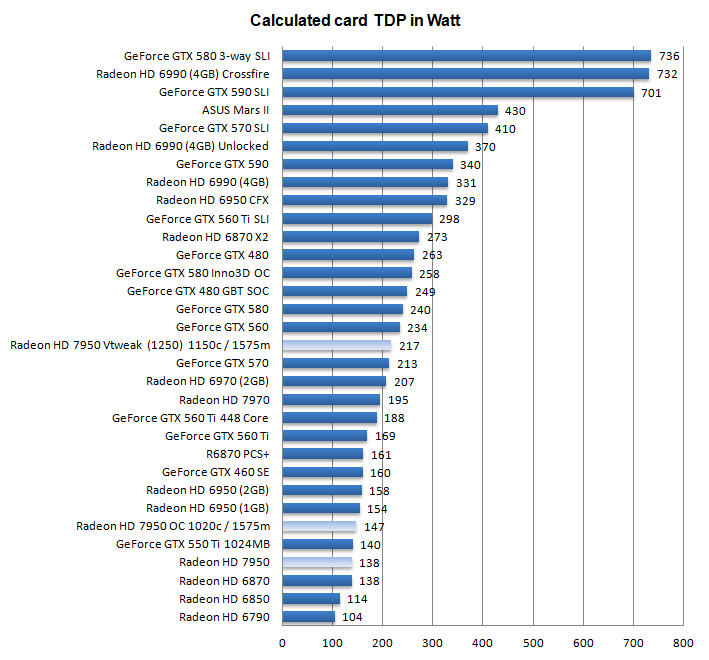
Above, a chart of relative power consumption. Again the Wattage shown is the card with the GPU(s) stressed 100%, showing only the peak GPU power draw, not the power consumption of the entire PC and not the average gaming power consumption.
