Guru3D.com
  • HOME
  • NEWS
    • Channels
    • Archive
    • Search
    • Submit
  • DOWNLOADS
    • New Downloads
    • Categories
    • Archive
    • Search
    • Submit
  • GAME REVIEWS
  • ARTICLES
    • Editorials
    • Guru3D VGA Charts
    • Rig of the Month
    • Join ROTM
    • PC Buyers Guide
    • Dated content
    • More Categories
  • HARDWARE REVIEWS
    • Videocards
    • Processors
    • Audio
    • Motherboards
    • Memory and Flash
    • SSD Storage
    • Chassis
    • Power Supply
    • Laptop and Mobile
    • Smartphone
    • Networking
    • Keyboard Mouse
    • Cooling
    • Knowledgebase
    • Search articles
    • More Categories
  • FORUMS
  • SEARCH
    • Search Articles
    • Search News
    • Search Files
  • NEWSLETTER
  • CONTACT

New Reviews
EVGA GeForce GTX 780 SC ACX review
Gigabyte GeForce GTX 780 WindForce 3x OC review
GeForce GTX 780 SLI and Multi monitor review
GeForce GTX 780 review
OCZ Vertex 450 SSD review
Gigabyte GeForce GTX 650 Ti Boost OC WindForce 2X review
MSI Radeon HD 7790 TurboDuo OC review
Metro Last Light VGA Graphics Benchmark performance test
Noctua NH-U12S and NH-U14S review
ASUS GeForce GTX 670 DirectCU Mini review

New Downloads
PrecisionX Download Version 4.2.0
GeForce 320.18 WHQL Driver Download
AMD Catalyst Application Profile Download 13.5 CAP1
MSI Afterburner 3.0.0 Beta 10 Download
PhysX System Software 9.13.0325 Download
GPU-Z Download 0.7.1
HWiNFO32 4.18 Download
HWiNFO64 4.18 Download
GeForce 320.14 BETA Driver Download
Nvidia Lifelike Human Face Rendering Tech Demo Download


New Forum Topics
by: hulawafu77 What games actually use the multi-threaded SSE supported PhysX 3.0?by: dk_lightning Mouse/Input Lagby: BetA March against MONSANTO - 25 May - Worldwideby: devil+ no boot!!!!!!!!!!!!!by: Jetl33 Rampage iv formula CPU infoby: WhiteLightning Nvidia demonstrate physx in hawkenby: bishi Geforce GTX 780 Owners Clubby: stasio Nvidia GeForce 320.18 WHQL Download and Discussionby: anf will haswell be quicker....by: lucidus Suggestions for new build?


Online Users
There are currently 1873 user(s) online:
Google, Live Search, matrix6100, MSN, Yahoo


Guru3D.com » Review » Prolink PixelView GeForce 6600 GT SLI » Page 3

Prolink PixelView GeForce 6600 GT SLI

Posted by Hilbert Hagedoorn on: 02/20/2005 08:00 AM [ 0 comment(s) ]

Page 3
TweetSLI Explained

Although adopting the similar name 'SLI' as used in the 3dfx era, the two really can not be compared. We are not going in-depth as you all understand the principles and ideas of utilizing two graphics cores. The technology behind that is fascinating yet not something most of you really care about, we'll handle a short explanation though. SLI is short for Scalable Link Interface.

Most GeForce 6600 and 6800 models have an internal architecture that allows the graphics core's to work in pairs. When the two GPU's work in pairs (parallel) they'll start load-balancing the workload. To explain it very simply I'll throw in a small explanation of one of the rendering methods. Each graphics core can render either the upper or lower half of the screen. The frame (single image) is divided in two, calculated and then merged back together.

You can understand that this requires some hefty CPU power so you better be sure to have a high-end processor in your PC. And with High-end I really mean a Pentium 4 3.4 GHz, Athlon 64 3200+ or equivalent to that which I consider to be the bare minimum.
Copyright Guru3D.com 2005
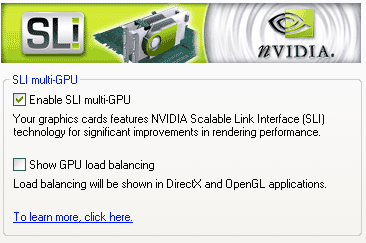
Once you installed your drivers new SLI options become available.

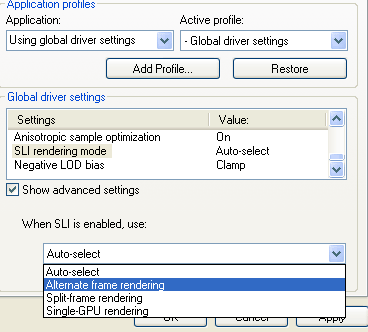
When you have a SLI capable solution active (see above picture) rendering can take place in three modes. If your game is not supported automatically Single GPU rendering will be enabled. When the game does support SLI then the driver will select the best SLI mode, which is either Alternate (AFR) or Split Frame (SFR) rendering. Let's have a quick explanation on them.
Copyright 2005 - Guru3D.com
Among the new options SLI rendering modes

SFR - Split frame rendering. Each graphics core is going to render a part of the screen, split horizontally. One card is responsible for the top section of the screen, the secondary card is responsible for the bottom. That situation is then load balanced as described above.

AFR - Alternate frame rendering. Each graphics core is rendering a frame at a time, odd and even. The full frame is prepared by the CPU and forwarded to the driver, which makes it render on each device to render a frame in turn. This is interleaving. First card A does a frame then card B the other.

As it seems AFR is NVIDIA's preferred method of rendering while using SLI. However SFR, I think, would be the way to go performance wise. But it boils all down to whether the game can handle it or not.

Something I dislike a bit is NVIDIA's approach to support for SLI. SLI is not something you get out of the box. The game must support it and if it does it'll be supported through NVIDIA's drivers. Now don't get me wrong, the majority of games are supported, especially the more popular and bigger titles, our tests will show you that. Next to that you'll need to consider this, people assume that SLI immediately doubles the speed of all games and that's just not the case. Several games do not support SLI. Looking from another point of view you can't expect a new technology to be perfect and fully supported by all games and drivers. NVIDIA has a big task ahead of them, SLI support standard out of the box.

One small thing, if a game is not tested and included in the NVIDIA drivers you can still force and enable SLI on it. If it'll work properly, that question remains to be seen. Suffice to say that all upcoming games will not have a problem with SLI.

I Demand Powerrrr


What you also need to realize is you will likely require a new higher-powered power supply, as twice the fun is twice your power bill.

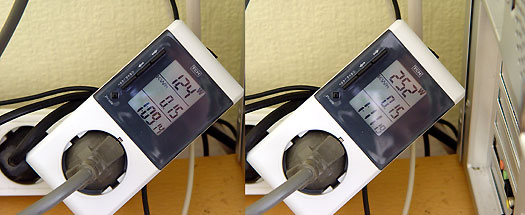
The power draw was relatively low though. With an Athlon 64 4000+ based system with two HD's, a DVD-Rom, 512 MB memory in-game the PC pulled a maximum of 250-260 Watt. You need some reserve though. So don't go thinking that a 300 Watt PSU is sufficient. Btw and before you go thinking, yeah right how on earth does he know that. Simple we have a Wattage meter between the PC and the power outlet.
Copyright Guru3D.com 2005
To your left the PC in idle, to your right 3DMark05 is running and power usage is maxing out.


19 pages « 2 3 4 5 next »


Guru3D.com » Articles » Prolink PixelView GeForce 6600 GT SLI » Page 3

Related Articles
Prolink PixelView GeForce 6600 GT SLI
Two 128MB GeForce 6600 GT's in one PC, bridged together in SLI mode. That's what we'll be reviewing today. The cards are being made by that lovely company called Prolink, and the product series is of course PixelView.

Prolink GeForce 6600 GT AGP8x review
Ever since Christmas 2004 when the AGP version of the GeForce 6600GT became available these little puppies where flying over the counter. They are hot, and they are selling. And they should as the GeForce 6600 GT offers really nice performance with a feature set that is completely up-to-date for a price that everyone is willing to spend, if you are a gamer that is.

Prolink PixelView GeForce 6600 Ultimate review
Another week another GeForce 6600 review. And I'm afraid this will continue to do so for the next couple of weeks. The GeForce 6600 is hitting the market hard as this is going to be a graphics card that is affordable yet offers some really good value for it's money. Today's product review is no less of that.. Last week we received a new sample from the good folks of Prolink, a company with a reputation to do things differently. Plasma cooling, PDF technology are two thing that come to mind immediately.

Prolink PixelView GeForce FX 5700 review
So, today's product we are going to review is the Prolink GeForce FX 5700 armed with video in/out, 256 MB memory and a sub 25dB cooling solution which is equipped with something that is called PDF, no note the Adobe one, it's called Plasma Display Fan. I hear you say .. 'Say waah ?' Hey don't ask me either .. plasma ?

Follow Guru3D on Google+ - Facebook - YouTube - Twitter © 2013