
Guru3D.com
  • HOME
  • NEWS
    • Channels
    • Archive
    • Search
    • Submit
  • DOWNLOADS
    • New Downloads
    • Categories
    • Archive
    • Search
    • Submit
  • GAME REVIEWS
  • ARTICLES
    • Editorials
    • Guru3D VGA Charts
    • Rig of the Month
    • Join ROTM
    • PC Buyers Guide
    • Dated content
    • More Categories
  • HARDWARE REVIEWS
    • Videocards
    • Processors
    • Audio
    • Motherboards
    • Memory and Flash
    • SSD Storage
    • Chassis
    • Power Supply
    • Laptop and Mobile
    • Smartphone
    • Networking
    • Keyboard Mouse
    • Cooling
    • Knowledgebase
    • Search articles
    • More Categories
  • FORUMS
  • SEARCH
    • Search Articles
    • Search News
    • Search Files
  • NEWSLETTER
  • CONTACT

New Reviews
MSI Radeon HD 7790 TurboDuo OC review
Metro Last Light VGA Graphics Benchmark performance test
Noctua NH-U12S and NH-U14S review
ASUS GeForce GTX 670 DirectCU Mini review
OCZ Vertex 3.20 SSD review
Cooler Master Eisberg 240L Prestige review
Guru3D and OCZ Contest - PC Power 1200W PSU Giveaway
MSI GeForce GTX 650 Ti BOOST OC review
ASUS ROG ORION PRO Gaming Headset Review
Guru3D Rig of the Month - April 2013

New Downloads
GPU-Z Download 0.7.1
HWiNFO32 4.18 Download
HWiNFO64 4.18 Download
GeForce 320.14 BETA Driver Download
Nvidia Lifelike Human Face Rendering Tech Demo Download
3DMark Download v1.1.0
XBMC Media Center Download 12.0 2
RTSS Rivatuner Statistics Server Download v5.1.1
AS SSD Benchmark Download v1.7.4739.38088
AMD Catalyst Application Profile Download 13.4 CAP1


New Forum Topics
by: CeeJay.dk SweetFX Shader Suite release and discussion thread #3by: Damien_Azreal Shadow Warrior - Reimaginingby: NiukNiuk Guild Wars 2 Design Manifestoby: Andrew Neilson Replacment for dogy Nvidia cards in ATIby: boe Where to buy a 140mm SLI cable?by: dellon132 ATI Catalyst 12.11 Beta 11 Modded driver For Legacy GPUby: AC_Avatar100400 Hyper 212 Evo Stock Fan Replacementby: Neo Cyrus Stylish Case Suggestions?by: Anarion 2013 IIHF Ice Hockey World Championship threadby: morbias Eurovision 2013


Online Users
There are currently 2232 user(s) online:
Google, iancook221188, John Dolan, keroro185, leopr, Live Search, MSN, PowerK, Starfighter2, Yahoo, yasamoka


Guru3D.com » Review » Palit GeForce GTX 670 JetStream review » Page 1

Palit GeForce GTX 670 JetStream review

Posted by Hilbert Hagedoorn on: 05/09/2012 01:00 PM [ 0 comment(s) ]

Introduction
Tweet


Palit GeForce GTX 670

The GeForce GTX 670 review galore has started. In this review we'll look at a very nice offering from Palit, a factory overclocked, custom cooled, custom designed PCB GeForce GTX 670. This product has all factors right.

The GeForce GTX 670 is the little brother of the GTX 680 and comes, well how to put it ... slightly castrated. NVIDIA disabled a couple of shader processors and designed a more cost effective and smaller PCB. 

The card itself is still quite beefy in terms of performance though, which you'll understand once we sift through the specifications. The GK104 GPU based graphics card has one SM/SMX cluster disabled. This gives the GK104 GPU 1344 CUDA cores to work with, with in total 112 texture and 32 raster operating units. 

The card itself is still quite beefy in terms of performance though, which you'll understand once we sift through the specifications. The GK104 GPU based graphics card has one SM/SMX cluster disabled. This gives the GK104 GPU 1344 CUDA cores to work with, with 112 texture and 32 raster operating units in total.

The graphics card also has slightly slower clock frequencies than big poppa GTX 680, with a reference baseclock speed of 915 MHz. However the GTX 670 comes with a Boost clock which is set at 980 MHz -- not far off from the GTX 680 at all.

Palit however released the JetStream version which comes pre-overclocked at 1006 MHz on the baseclock and an impressive 1084 MHz on the boost clock. More interestingly, the boost clock during our test sessions was actually closer to 1200 MHz most of the time (!).

To give the card enough framebuffer to work with, the cards are equipped with 2048 GDDR5 on a 256-bits wide bus. Palit clocks this memory at 6108 MHz (6008 = reference clock).

With a slightly increased TDP at roughly 180 Watts the card won't draw too much power either. With that said you have the more important variables in your mindset, have a peek at the product after which we dive right into the review, next page please.
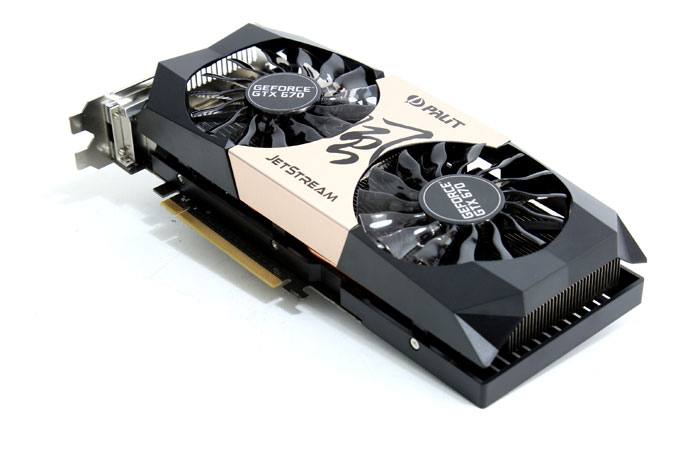
Palit GeForce GTX 670


24 pages 1 2 3 4 next »


Guru3D.com » Articles » Palit GeForce GTX 670 JetStream review » Page 1

Related Articles
Palit GeForce GTX 650 Ti Boost OC edition review
For this review we test and benchmark the Palit GeForce GTX 650 Ti Boost OC edition. The product comes customized with their own PCB design, a dual-fan cooler, 2GB of memory with both that memory and the core baseclock slightly overclocked.

Palit GeForce GTX 660 Ti Jetstream review
In this review we'll look at the GeForce GTX 660 Ti from Palit, it's their all beefed up version, the GeForce GTX 660 Ti JetStream version. The GTX 660 Ti again has been equipped with a JetStream series cooler yet which remains a 3-slot design. It runs at a core clock frequency of 1006 MHz, has a boost frequency of 1085 MHz and the effective memory data rate (192-bit) is 6108 MHz.

Palit GeForce GTX 670 JetStream review
We review the Palit GeForce GTX 670 JetStream graphics card. the JetStream version which comes pre-overclocked at 1006 MHz on the baseclock and an impressible 1084 MHz on the boost clock. More interestingly, the boost clock during our test sessions was actually closer to 1200 MHz most of the time (!). To give the card enough framebuffer to work with the cards are equipped with 2048 GDDR5 on a 256-bits wide bus. Palit clocks this memory at 6108 MHz.

Palit GeForce GTX 680 4GB Jetstream review
We review the Palit GeForce GTX 680 4GB Jetstream edition. Why 4 GB ? Well some of you like to game at extremely high resolutions or have 8xAA as a bare minimum. If a graphics card runs out of graphics memory it'll starts swapping frames back and forward in that framebuffer which decreases the overall framerate. So today we'll look at the 4GB model, we'll specifically place a focus at some tests at 2560x1600 with a good chunk of AA enabled to see what difference the extra 2GB graphics memory will bring us in terms of performance.

Follow Guru3D on Google+ - Facebook - YouTube - Twitter © 2013