Architecture overview
Oh hey now ! Welcome to page two. You obviously made the choice to go a bit deeper into the GPU with me, thank you for that. We'll try and keep things as easy to understand as possible.
So as stated, unfortunately we may not share any details on clock frequencies and card specific items on the upcoming boards, so please understand that this is a technology overview aka preview, and not a product review. Let's first look at the raw data that most of you can understand and grasp.
The GF100 will have:
- 512 CUDA processors (Unified Shader cores)
- 16 geometry units
- 4 raster Units
- 64 Texture Units
- 48 ROP engines
- 384-bit GDDR5 memory bus
- DirectX 11 compatible.
So the rumors are correct, the most high-end GF100 product will come with a wicked 512 shader processors (which NVIDIA renamed to CUDA cores). BTW note to NVIDIA, we like to call things what they are and not marketing brand everything, it's confusing for the end-users you know. Shader processors it is then.
The GF100 GPU will have a very strong focus on DX 11, geometry processing and tessellation and should become a gaming frag fest monster product in terms of performance. We'll actually show you some example video at the end of this article.
Let's first have a look at the block diagram of the GF100 GPU, which is referred to as GPC architecture (Graphics Processing Clusters).
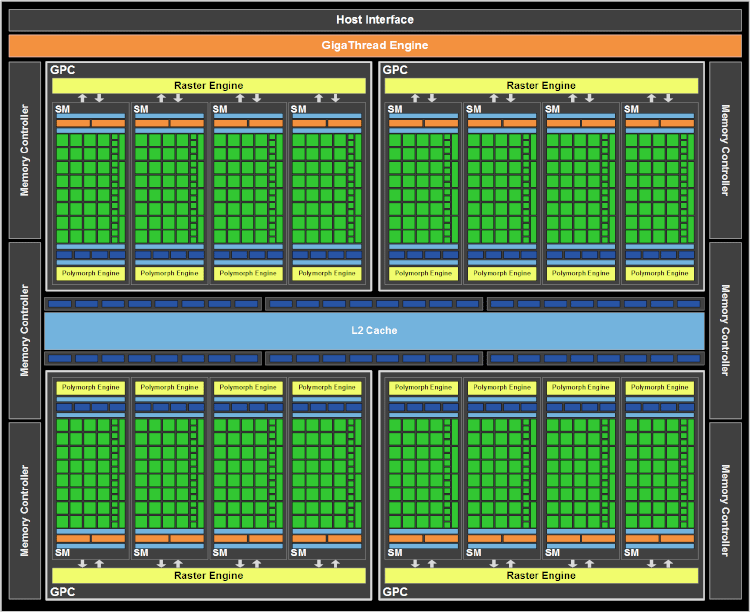
Above the GF100 host interface - The Gigathread engine, four GPCs, six memory controllers, ROP partitions, a 768KB L2 cache. Each GPC has four polymorph engines - ROP partitions are nearby to the L2 cache.
512 shader processors .. that's 272 cores more than the GT200 (GeForce GTX 280/285). GT200 had 30 ROPs, GF100 will have 48 for features like pixel blending and AA. GF100 will have a strong focus on geometry processing and tessellation. Shading performance is going be increased massively, geometry performance will get a x3 boost actually (and that's a lot). Let's break a Shader cluster down shall we?
The new pipeline is fairly fixed and modeled to DX11 requirements but there are certainly changes opposed and compared to last generation architecture. First off you'll notice sixteen clusters of shader processors (gigathread engines as named by NVIDIA) embedded into one GPC (graphics processing cluster). Now we're not going to explain over and over again what a shader processor is and does. Each shader cluster (four within a GPC cluster) has 32 shader cores tied to a geometry unit and four texture units (64 total). Each shader cluster then is tied to L1 and a shared L2 cache.
In regards to architectural changes, on top of the pipeline NVIDIA has now added new Polymorph (world space processing) and raster (screen space processing) engines, they act like a mini CPU really. But what you'll find to be the most interesting thing in the pipeline is the PolyMorph engine as that is a significant change in the architecture.
