Guru3D.com
  • HOME
  • NEWS
    • Channels
    • Archive
    • Search
    • Submit
  • DOWNLOADS
    • New Downloads
    • Categories
    • Archive
    • Search
    • Submit
  • GAME REVIEWS
  • ARTICLES
    • Editorials
    • Guru3D VGA Charts
    • Rig of the Month
    • Join ROTM
    • PC Buyers Guide
    • Dated content
    • More Categories
  • HARDWARE REVIEWS
    • Videocards
    • Processors
    • Audio
    • Motherboards
    • Memory and Flash
    • SSD Storage
    • Chassis
    • Power Supply
    • Laptop and Mobile
    • Smartphone
    • Networking
    • Keyboard Mouse
    • Cooling
    • Knowledgebase
    • Search articles
    • More Categories
  • FORUMS
  • SEARCH
    • Search Articles
    • Search News
    • Search Files
  • NEWSLETTER
  • CONTACT

New Reviews
MSI Radeon HD 7790 TurboDuo OC review
Metro Last Light VGA Graphics Benchmark performance test
Noctua NH-U12S and NH-U14S review
ASUS GeForce GTX 670 DirectCU Mini review
OCZ Vertex 3.20 SSD review
Cooler Master Eisberg 240L Prestige review
Guru3D and OCZ Contest - PC Power 1200W PSU Giveaway
MSI GeForce GTX 650 Ti BOOST OC review
ASUS ROG ORION PRO Gaming Headset Review
Guru3D Rig of the Month - April 2013

New Downloads
GPU-Z Download 0.7.1
HWiNFO32 4.18 Download
HWiNFO64 4.18 Download
GeForce 320.14 BETA Driver Download
Nvidia Lifelike Human Face Rendering Tech Demo Download
3DMark Download v1.1.0
XBMC Media Center Download 12.0 2
RTSS Rivatuner Statistics Server Download v5.1.1
AS SSD Benchmark Download v1.7.4739.38088
AMD Catalyst Application Profile Download 13.4 CAP1


New Forum Topics
by: Penal Stingray Wii U is Sweet!by: greg1993 GTX 660 sucks?by: Hilbert Hagedoorn Metal Gear Rising: Revengeance PC Port Confirmedby: killer_939 Considering going water, need advice :)by: Stoja AMD Catalyst 13.5 beta 3 Mobility Driverby: TwoPlusTwo 3DMark 11 Graphics Score Has Plummetedby: UnrealGaming Metal Gear Solid: Risingby: CeeJay.dk SweetFX Shader Suite release and discussion thread #3by: moab600 any going from 670/680-780?by: BlackZero Downsampling with AMD: Guide and Demonstration


Online Users
There are currently 1728 user(s) online:
cliffgamerz, Google, Live Search, MSN


Guru3D.com » Review » MSI Big Bang Trinergy review » Page 2

MSI Big Bang Trinergy review

Posted by Hilbert Hagedoorn on: 12/01/2009 02:00 PM [ 0 comment(s) ]

Specs and features
Tweet


Alright lads, meet the MSI Big bang Trinergy

You've been able to grasp by now that this motherboard is based on the high-end P55-GD80 model (LGA 1156 Core i5/i7 processors). The Big bang Trinergy motherboard comes with a scrumptious black PCB design and a cooling system that features SuperPipe technology (passive). Much like it's little sister the board boasts Dr MOS and APS (Active Phase Switching).

We again spot the handy OC Genie overclocking function and as stated on the previous page an NVIDIA NF 200 SLI bridge chip has now been embedded providing 32 extra PCIe lanes for the graphics setup allowing 3-way SLI, CrossfireX or say 2-way SLI and dedicated PhysX.

The MSI P55 GD80 Trinergy comes equipped with four memory slots rated at even DDR3-2133 (overclocked) and three PCI-Express x16 slots that thus provide 3-way SLI and CrossFireX support. You'll nearly get lost counting but you'll get ten SATA II ports and then two another eSATA ports. Obviously the board comes with dual Gigabit Ethernet and the other GD80 features like V-Check points, Power, Reset, Green Power and Clear CMOS buttons, and a FireWire connector.

To complement the board even further the Big Bang Trinergy comes bundled with a PCIe x1 Quantum Wave audio card that supports THX TruStudio PC and Creative EAX Advanced HD 5.0 Also you will spot an OC Dashboard (external) control pod device that enables users to do some quick, on-the-fly overclocking with the touch of a couple of buttons.

The motherboard comes with a 14-phase power circuit with standard solid-state capacitors. This board has a lot of overclock friendly features, such as on-board controls for clock-speeds, clear-CMOS, OC-Genie, a DIP switch to control voltages, and voltage-sensing points that make measuring voltages convenient.

Make no mistake, the design and implementation of this Trinergy might look like the P55 GD80, but the board design is completely overhauled and a lot is very different.

Let's talk about the P55 chipset empowering the Big Bang Trinergy for a minute though.

The P55 PCH - Platform Controller Hub

To understand the product we'll be reviewing today, let's first discuss the heart of the MSI P55 GD 80 Trinergy, the P55 PCH controller HUB. The P55 motherboard chipset is just one chip, no more North and Southbridge. Interesting to learn is that the P55 chipset connects to the processor directly through DMI (Direct media interface) interface bus, and that's different from X58 where it connects directly to the QPI link.

  • X58 = QPI bus LGA1366, 2 QPI links, 3xDDR3, plus power.
  • P55 = DMI bus, LGA1160/1156, 1 DMI link, 2xDDR3, PCI-E connections, plus power.

The P55 chip has embedded a lot of righteousness in it: we see an all-time first integrated PCIe controller for 16X or two eight-speed PCIe cards, when it comes to input / output capabilities we are talking about support for 14 USB 2.0 ports with integrated USB 2.0 Rate matching hubs, 6 SATA 3.0 Gb/s ports and an integrated Gigabit LAN Ethernet.

Especially the 16 PCIe lanes are on the shy side for multi-GPU configurations. As such MSI adds a NF200 chip here to gain more PCIe lanes and this bandwidth.

The chipset will also supports Integrated Clocking Buffer Through Mode, provides Thermal Sensor Data via SMBUS for discrete Fan Control Solutions and Intel Matrix Storage Technology 9.0. The new Intel matrix storage has a new user interface for managing all storage related tasks, support for RAID 0,1,5 and 10, Rapid recover technology.

DDR3 wise 1333 MHz is supported straight out of the box, but running the memory at 1600, 1866 or even 2000+ MHz should be no issue either. Speaking of memory, with the arrival of Core i7 870, 860 and i5 750 Intel made the decision to go back to a dual-channel memory interface. Don't get too worried here; the controller is so much faster than the old limited FSB based controllers. You'll have 64-bit memory wide controllers which are connected directly with the processors silicon. As a result this design brings a bandwidth utilization of as much as 90%, a nice jump from the FSB based 50-60% utilization for sure.

In this review we'll be using a 1600 MHz DDR3 Corsair Dominator memory kit. Corsair provided this kit specifically for this review. It is horribly sweet memory as its arranged as 2x4 = 8 GB of memory.
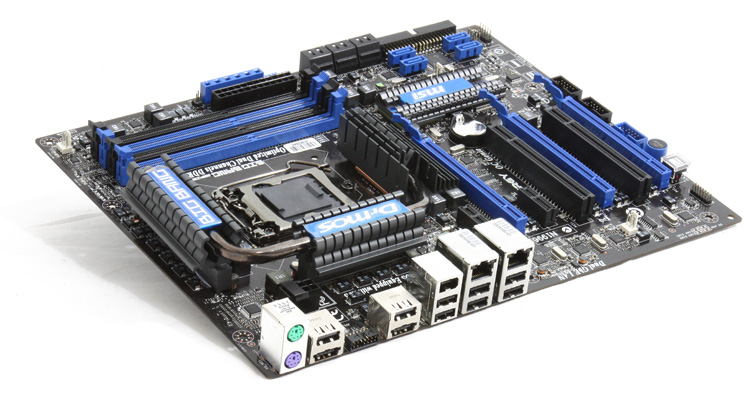
MSI Big Bang Trinergy


22 pages 1 2 3 4 next »


Guru3D.com » Articles » MSI Big Bang Trinergy review » Page 2

Related Articles
MSI Big Bang Z77 Mpower review
Today we test the Z77 MPower version, which as you'll notice is a pleasant upgrade from their Z77A-GD65 motherboard -- yet with an improved CPU VRM, more friendly warranties and a new black and yellow color-scheme which merges the Lightning series graphics cards and these motherboards a little closer together. Have a peek at what was just released, this is the MSI Big Bang Z77 MPower motherboard. You just have to be impressed by the overall looks ...

MSI Big Bang P67 Marshal review
Powered by Intel's P67 chipset, the MSI Big Bang Marhal comes with MSI's latest Military Class II design that makes use of a 24 phase (!) power SFC choke setup alongside the best quality Hi-c CAP's and Japanese made solid capacitors. Added to the mix for additional PCIe lanes is a Hydra chip, which also can be utilized to combine mix and match graphics cards in a multi-GPU setup. The board comes with 24-phase DrMOS power design, voltage monitoring points, an external overclock device called the OC dashboard, that all new EFI BIOS, dual-BIOS selectable with a simple button, and OC genie button that allows you to have say a 2500K processor run at 4200 with the flick of a switch. I'm not done though, we spot integrated audio with SoundBlaster X-Fi application (software) layer, ten SATA ports of which four are based on the all new SATA 6G. Thick heatpipe (passive and thus silent) cooling and more and more. This board is a true hardware enthusiast dream come true, or is it ?

MSI Big Bang X58 XPower review
We test and review the XPower from MSI. Last month Intel added a new processor in the line-up, the ever so strong Core i7 980 Extreme six-core processor. Seriously breathtaking, and to date the fastest consumer processor on the globe with very decent overclock potential as well. That was reason enough for most ODM to make new updates and revisions of the X58 chipset based motherboards, as next top the new processor we also have seen the gradual adoption of features like USB 3.0 and SATA3 6G. MSI is on of the ODMs releasing something really special, today we'll review the Big Bang X58 XPower motherboard. It is chucked full with the latest gadgets and features, it is equipped to make sure you get the very best overclock out of it and heck, even if you can't overclock, flick a button and the motherboard will do the work for you, completely automated.

MSI Big bang Fuzion (Lucid Hydra) review
MSI has yet another motherboard lined up in the P55 motherboard Big Bang series, ready and waiting for you. It's called the 'Fuzion' and comes with that much discussed Lucid Hydra 200 chip. Now the big deal about the Big Bang mainboard is that the board has that Lucid Hydra 200 chip that allows it to support multiple video cards of different brands and models at once. This in theory would allow you get the extra performance from your old video card and your new card even if one is NVIDIA and the other is ATI. The Hydra 200 is a real-time distributed processing engine that acts as an intelligent graphics load balancer.

Follow Guru3D on Google+ - Facebook - YouTube - Twitter © 2013