Guru3D.com
  • HOME
  • NEWS
    • Channels
    • Archive
    • Search
    • Submit
  • DOWNLOADS
    • New Downloads
    • Categories
    • Archive
    • Search
    • Submit
  • GAME REVIEWS
  • ARTICLES
    • Editorials
    • Guru3D VGA Charts
    • Rig of the Month
    • Join ROTM
    • PC Buyers Guide
    • Dated content
    • More Categories
  • HARDWARE REVIEWS
    • Videocards
    • Processors
    • Audio
    • Motherboards
    • Memory and Flash
    • SSD Storage
    • Chassis
    • Power Supply
    • Laptop and Mobile
    • Smartphone
    • Networking
    • Keyboard Mouse
    • Cooling
    • Knowledgebase
    • Search articles
    • More Categories
  • FORUMS
  • SEARCH
    • Search Articles
    • Search News
    • Search Files
  • NEWSLETTER
  • CONTACT

New Reviews
MSI Radeon HD 7790 TurboDuo OC review
Metro Last Light VGA Graphics Benchmark performance test
Noctua NH-U12S and NH-U14S review
ASUS GeForce GTX 670 DirectCU Mini review
OCZ Vertex 3.20 SSD review
Cooler Master Eisberg 240L Prestige review
Guru3D and OCZ Contest - PC Power 1200W PSU Giveaway
MSI GeForce GTX 650 Ti BOOST OC review
ASUS ROG ORION PRO Gaming Headset Review
Guru3D Rig of the Month - April 2013

New Downloads
GPU-Z Download 0.7.1
HWiNFO32 4.18 Download
HWiNFO64 4.18 Download
GeForce 320.14 BETA Driver Download
Nvidia Lifelike Human Face Rendering Tech Demo Download
3DMark Download v1.1.0
XBMC Media Center Download 12.0 2
RTSS Rivatuner Statistics Server Download v5.1.1
AS SSD Benchmark Download v1.7.4739.38088
AMD Catalyst Application Profile Download 13.4 CAP1


New Forum Topics
by: Hilbert Hagedoorn Steam's Weekly Top Sellers May 20 2013by: eighty1 help upgrading cpu mobo and some queries.by: dsbig max temp,cooling,noise levelby: xodius80 Will this be an Updrageby: villa_youth Metro: Last Lightby: antonyfrn Giving away DOTA2 keysby: Stone Gargoyle Batman Returns in 2013by: UnrealGaming Resident Evil 6by: mentalpeace Borderlands 2 + MSI 670 oc + Physx Highby: hallryu Windows 8 #2


Online Users
There are currently 1696 user(s) online:
CronoGraal, Dillinger, Google, Live Search, Memorian, MSN, Watcher, Yahoo


Guru3D.com » Review » Geforce GTX 680 review » Page 4

Geforce GTX 680 review

Posted by Hilbert Hagedoorn on: 03/21/2012 02:00 PM [ 0 comment(s) ]

Power efficiency - Dyn Clock Adjustment
Tweet


Power efficiency

Moving towards a 28nm based chip means you can do more with less as the product becomes smaller, the GK104 GPU comes with roughly 3.54 billion transistors embedded into it. The TDP (maximum board power) sits at a very respectable 195 Watts. So in one hand you have a graphics card that uses less power, yet offers more performance. That's always a big win!

The GeForce GTX 680 comes with two 6-pin power connectors to get enough current and a little spare for overclocking. This boils down as: 2x 6-pin PEG = 150W + PCIe slot = 75W is 225W available (in theory). We'll measure all that later on in the article but directly related is the following chapter.

Dynamic Clock Adjustment technology

Kepler GPU will feature a Dynamic Clock Adjustment technology and we can explain it easily without any complexity. Typically when your graphics card idles the cards clock frequency will go down... yes?

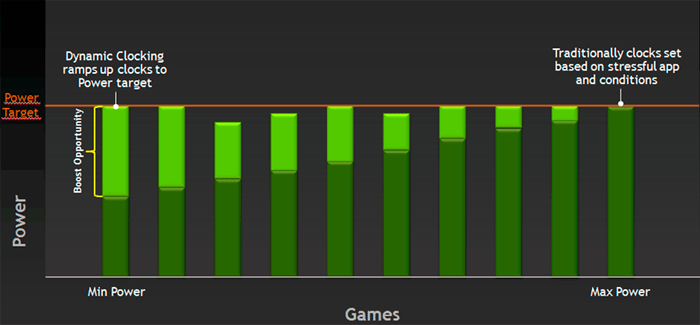
Well, obviously Kepler architecture cards will do this as well, yet now it works vice versa as well. If in a game the GPU has room left for some more, it will increase the clock frequency a little and add some extra performance. You could say that the graphics card is maximizing it's available power threshold.
GeForce GTX 680
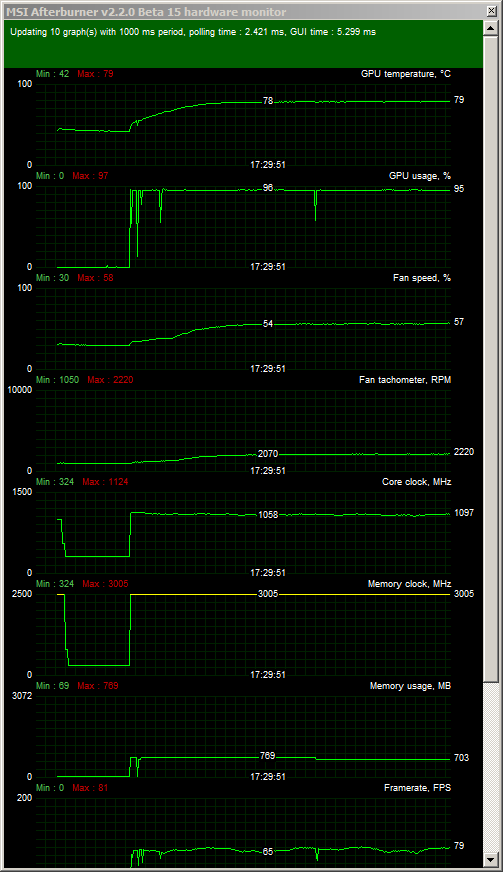
Example of a stress test applied to the GPU, where the baseclock of 1006/1058 MHz goes much higher, climbing to even 1124 MHz.

Even more simple, DCA resembles Intel’s Turbo Boost technology a little bit by automatically increasing the graphics core frequency with 5 to 10 percent when the card works bellow its rated TDP. The baseclock of the GTX 680 in 3D mode is 1006 MHz, it can now boost towards 1058 MHz when the power envelope allows it to do so. The 'Boost Clock' however is directly related to the maximum board power, so it might clock even higher as longs as the GPU sticks within it's power target. We've seen the GPU run to an excess of even over 1100 MHz for brief periods of time.

Overclocking on that end will work the same as GPU boost will continue to work while overclocking, it stays restricted within the TDP bracket. We'll show you that in out overclocking chapter.


26 pages « 3 4 5 6 next »


Guru3D.com » Articles » Geforce GTX 680 review » Page 4

Related Articles
ASUS GeForce GTX 670 DirectCU Mini review
In this article we review the ASUS GeForce GTX 670 DirectCU Mini edition, a compact performance graphics card designed primarily for small form factor PCs with mini ITX motherboards. The dual-slot card measures just 17cm and features the NVIDIA GTX 670 GPU. ASUS has re-engineered the DirectCU cooler to fit small form factor cases. While shorter, it introduces a copper vapor chamber placed directly on top of the GPU for faster heat spreading and dispersal with 20% lower temperatures than reference GTX 670.

MSI GeForce GTX 650 Ti BOOST OC review
In this article we review the MSI GeForce GTX 650 Ti BOOST OC edition review with that OC for a factory tweak. The product is customized with a new PCB, cooling and a few tweaks, it has 2GB of memory with both that memory and the core base-clock slightly overclocked. Overall an interesting product at an interesting price in the lower segment of the mainstream market.

EVGA GeForce GTX 650 Ti Boost SC edition review
In this article we review the EVGA GeForce GTX 650 Ti Boost SC edition review with that SC for superclocked. The product is fairly reference looking but does come with EVGA's own styled cooler, it has 2GB of memory with both that memory and the core baseclock slightly overclocked quite significant.

Palit GeForce GTX 650 Ti Boost OC edition review
For this review we test and benchmark the Palit GeForce GTX 650 Ti Boost OC edition. The product comes customized with their own PCB design, a dual-fan cooler, 2GB of memory with both that memory and the core baseclock slightly overclocked.

Follow Guru3D on Google+ - Facebook - YouTube - Twitter © 2013