Guru3D.com
  • HOME
  • NEWS
    • Channels
    • Archive
    • Search
    • Submit
  • DOWNLOADS
    • New Downloads
    • Categories
    • Archive
    • Search
    • Submit
  • GAME REVIEWS
  • ARTICLES
    • Editorials
    • Guru3D VGA Charts
    • Rig of the Month
    • Join ROTM
    • PC Buyers Guide
    • Dated content
    • More Categories
  • HARDWARE REVIEWS
    • Videocards
    • Processors
    • Audio
    • Motherboards
    • Memory and Flash
    • SSD Storage
    • Chassis
    • Power Supply
    • Laptop and Mobile
    • Smartphone
    • Networking
    • Keyboard Mouse
    • Cooling
    • Knowledgebase
    • Search articles
    • More Categories
  • FORUMS
  • SEARCH
    • Search Articles
    • Search News
    • Search Files
  • NEWSLETTER
  • CONTACT

New Reviews
Gigabyte GeForce GTX 650 Ti Boost OC WindForce 2X review
MSI Radeon HD 7790 TurboDuo OC review
Metro Last Light VGA Graphics Benchmark performance test
Noctua NH-U12S and NH-U14S review
ASUS GeForce GTX 670 DirectCU Mini review
OCZ Vertex 3.20 SSD review
Gigabyte Radeon HD 7790 2GB OC review
Cooler Master Eisberg 240L Prestige review
Guru3D and OCZ Contest - PC Power 1200W PSU Giveaway
MSI GeForce GTX 650 Ti BOOST OC review

New Downloads
MSI Afterburner 3.0.0 Beta 10 Download
PhysX System Software 9.13.0325 Download
GPU-Z Download 0.7.1
HWiNFO32 4.18 Download
HWiNFO64 4.18 Download
GeForce 320.14 BETA Driver Download
Nvidia Lifelike Human Face Rendering Tech Demo Download
3DMark Download v1.1.0
XBMC Media Center Download 12.0 2
RTSS Rivatuner Statistics Server Download v5.1.1


New Forum Topics
by: Hilbert Hagedoorn Microsoft Xbox One console shownby: UnrealGaming The Incredible Adventures of Van Helsingby: kiya Firefox based browsers slow and stutteringby: dk_lightning Mouse/Input Lagby: Agent-A01 Geforce GTX TITAN Owner Clubby: Glidefan Vehicles of Guru3D thread #2by: RedSeptember Call of Juarez - Gunslingerby: Hilbert Hagedoorn NVIDIA GeForce GTX 780, GTX 770 and GTX 760 Tiby: Rich_Guy AMD Catalyst 13.5 CAP 1 Releasedby: Frances Butterfly Labs


Online Users
There are currently 1802 user(s) online:
Google, Koniakki, Live Search, MSN, Samy, sk33, smashly, volkov956, Yahoo, Zenoth


Guru3D.com » Review » Geforce GTX 680 review » Page 25

Geforce GTX 680 review

Posted by Hilbert Hagedoorn on: 03/21/2012 02:00 PM [ 0 comment(s) ]

Overclocking the graphics card
Tweet


Overclocking the graphics card

As most of you know, with most video cards you can apply a simple series of tricks to boost the overall performance a little. You can do this at two levels, namely tweaking by enabling registry or BIOS hacks, or very simply to tamper with Image Quality. And then there is overclocking, which will give you the best possible results by far.

What do we need?
One of the best tools for overclocking NVIDIA and ATI videocards is our own AfterBurner which will work with 90% of the graphics cards out there. We can really recommend it, download here.

Where should we go?
Overclocking: By increasing the frequency of the videocard's memory and GPU, we can make the videocard increase its calculation clock cycles per second. It sounds hard, but it really can be done in less than a few minutes. I always tend to recommend to novice users and beginners, to not increase the frequency any higher than 5% on the core and memory clock. Example: If your card runs at 600 MHz (which is pretty common these days) then I suggest that you don't increase the frequency any higher than 30 to 50 MHz.

More advanced users push the frequency often way higher. Usually when your 3D graphics start to show artifacts such as white dots ("snow"), you should back down 10-15 MHz and leave it at that. Usually when you are overclocking too hard, it'll start to show artifacts, empty polygons or it will even freeze. Carefully find that limit and then back down at least 20 MHz from the moment you notice an artifact. Look carefully and observe well. I really wouldn't know why you need to overclock today's tested card anyway, but we'll still show it.

All in all... do it at your own risk.

Original This sample Overclocked
Core Clock: 1006 MHz Core Core Clock: 1006 MHz Core Clock: 1264 MHz
Boost Clock: 1058 MHz Boost Clock: 1058 MHz Boost Clock: 1264 MHz
Memory Clock: 6000 MHz Memory Clock: 6000 MHz Memory Clock: 6634 MHz

Now with the Dynamic boost function of the series 600 cards overclocking is definitely going to be more complicated. It remains simple though. Mind you that for overclocking we used an unreleased version AfterBurner.
GeForce GTX 680

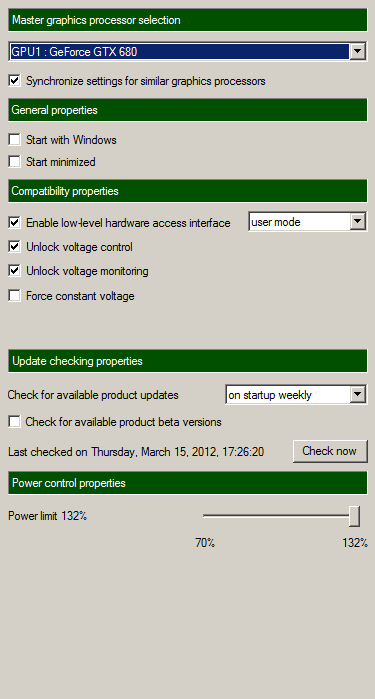
In afterburner we go into the preferences. We can widen up the TDP limitations a bit, set the power limiter towards 132%. That way the Dynamic boost function won't down clock all the time to meet it's upper threshold in TDP limitations.

Mind you that Voltage tweaking was at he time of writing not yet available. So once that is ready we'll likely publish another "extreme" overclocking article.
GeForce GTX 680

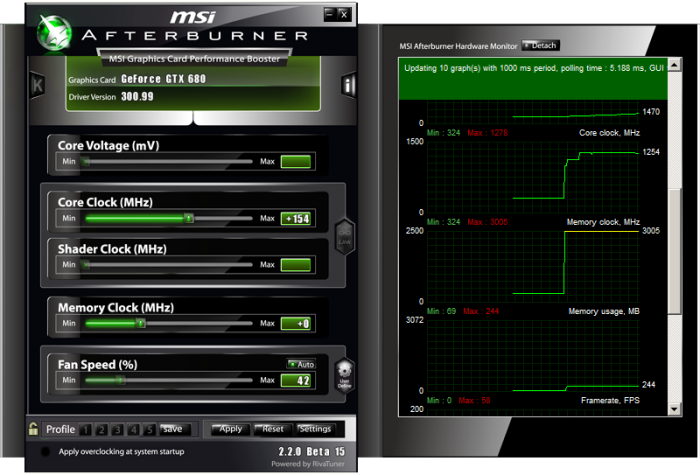
We now add another 154MHz towards the graphics core and end at roughly 1250 MHz on the core. In the upper monitoring graph you can see that we had a stress application running in the background. The dynamic clock will still kick in albeit not extreme.

So for the core we ended at 1264 MHz absolutely stable and for the memory we ended at 6634 MHz (effective data rate).  At this stage under stress the cooler RPM went up a little as such the noise level now has risen towards roughly 42~43 DBa, still very doable.

We now have some extra performance at our hands, have a peek at the results when overclocked.
GeForce GTX 680

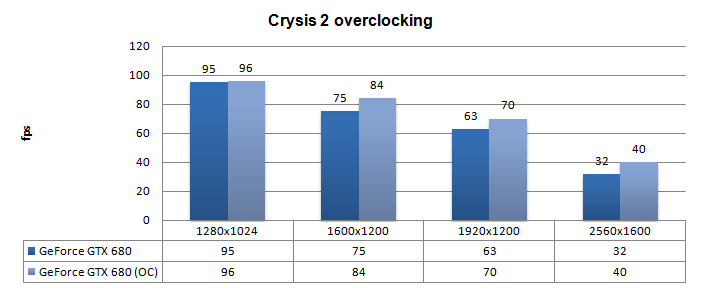
Above, Crysis 2, same maxed out image quality settings as before yet now with added overclock results:

  • DirectX 11
  • High Resolution Texture Pack
  • Ultra Quality settings
  • 4x AA
  • Level - Times Square (2 minute custom time demo)
GeForce GTX 680

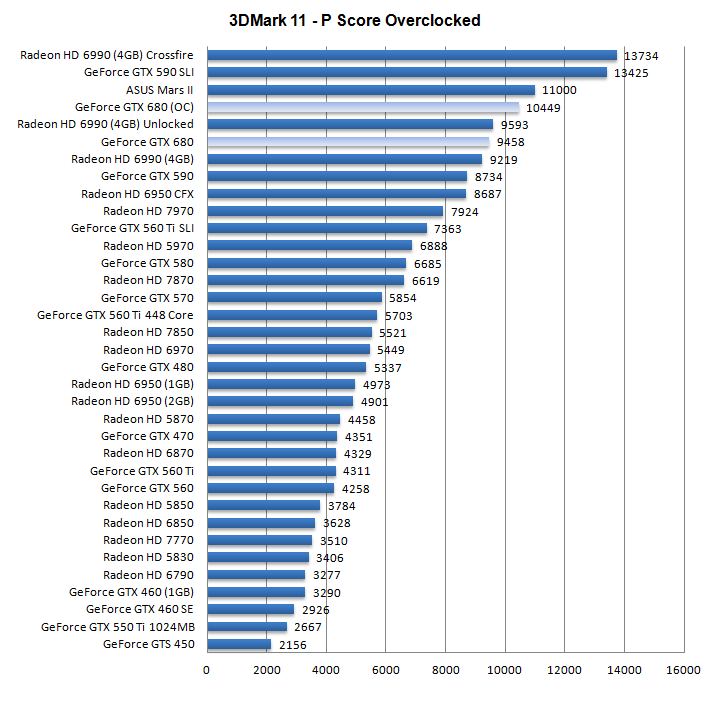
Above, 3DMark 11 - the Performance test and score. As you can see, there is an additional bump in this very GPU limited software, lovely.
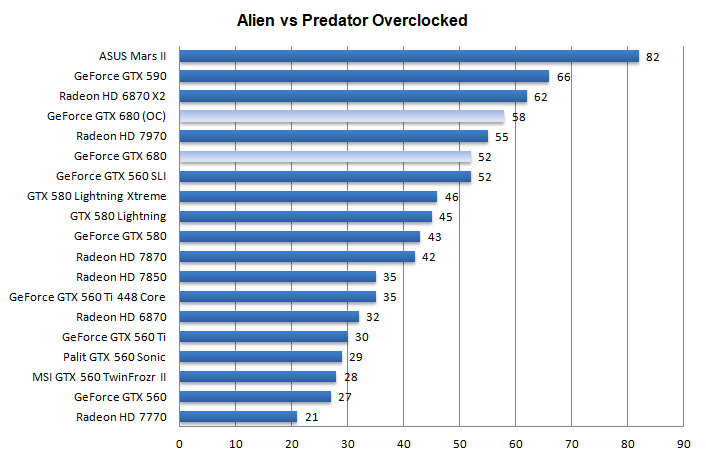
GeForce GTX 680

Above, Alien versus Predator, in 1920x1200 at 4xAA and 16X anisotropic filtering


26 pages « < 23 24 25 26


Guru3D.com » Articles » Geforce GTX 680 review » Page 25

Related Articles
Gigabyte GeForce GTX 650 Ti Boost OC WindForce 2X review
In this article we review the Gigabyte GeForce GTX 650 Ti Boost OC WindForce 2X with that OC for a factory tweak and the Windforce indicating a silent yet powerful two fan cooling solution. The product is customized with a new PCB, cooling and a few tweaks, it has 2GB of memory with both that memory and the core base-clock slightly overclocked. An tasty product at an interesting price in the lower segment of the mainstream market.

ASUS GeForce GTX 670 DirectCU Mini review
In this article we review the ASUS GeForce GTX 670 DirectCU Mini edition, a compact performance graphics card designed primarily for small form factor PCs with mini ITX motherboards. The dual-slot card measures just 17cm and features the NVIDIA GTX 670 GPU. ASUS has re-engineered the DirectCU cooler to fit small form factor cases. While shorter, it introduces a copper vapor chamber placed directly on top of the GPU for faster heat spreading and dispersal with 20% lower temperatures than reference GTX 670.

MSI GeForce GTX 650 Ti BOOST OC review
In this article we review the MSI GeForce GTX 650 Ti BOOST OC edition review with that OC for a factory tweak. The product is customized with a new PCB, cooling and a few tweaks, it has 2GB of memory with both that memory and the core base-clock slightly overclocked. Overall an interesting product at an interesting price in the lower segment of the mainstream market.

EVGA GeForce GTX 650 Ti Boost SC edition review
In this article we review the EVGA GeForce GTX 650 Ti Boost SC edition review with that SC for superclocked. The product is fairly reference looking but does come with EVGA's own styled cooler, it has 2GB of memory with both that memory and the core baseclock slightly overclocked quite significant.

Follow Guru3D on Google+ - Facebook - YouTube - Twitter © 2013