Introduction
| Product: | Solid State Disk 64 Gb 2.5" SATA II |
| Manufacturer: | G.Skill |
| SKU code: | FM-25S2S-64GB |
| Information: | website |
| Street price: | 159 USD/EUR |
 It's time for another Solid State Disk review you guys; this time from the folks at G.Skill. Man the performance of SSD drives seems to get faster with each month that passes. A month or two ago when we reviewed the OCZ Core MLC SSD we where overwhelmed really. Such an SSD ended up in my primary work PC as a boot drive and is now running Vista. And yeah, I like it a lot. It's speedy and fast for sure. Within the same MLC segment (we'll explain MLC shortly) a lot of manufacturers jumped on-board with SSD development. One of them is G.Skill and they just launched a rather nicely priced series of SSDs.
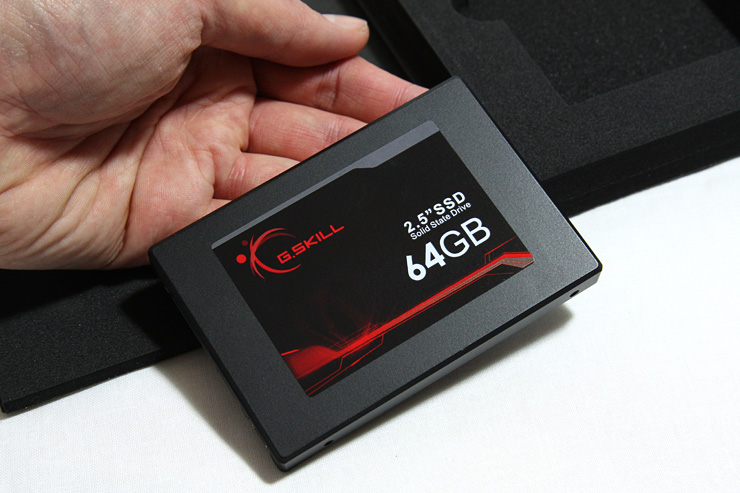
Today we'll peek at one of their finest drives available in a 64 GB flavor. It comes with an advertised performance of 155 MB/sec read speed and a 90 MB/sec write speed, which makes it faster than the OCZ Core product I am so fond off.
This new SSD is MLC-based and measures in at just 2.5-inchehbgvsghbv, easily placed in a desktop PC, and obviously a perfect fit for your laptop. With a SATA II interface type and a built-in EDC/ECC protection, this G.SKILL drive is ready to handle your data for sure. The G.SKILL FM-25S2S will be in two sizes, the 64GB model and the 128GB model.
So in this review we'll look at the G.Skill 64GB SSD which you can find under part number FM-25S2S-64GB at a sales price of roughly $159 (USD). The 128 GB version costs roughly 279 USD.
I've stated it before, SSD storage is the future, make no mistake. Pricing is still a bit hefty, but with prices roughly halving each year, we entered a stage in this industry where they are slowly getting affordable. Next to the prices going down, the overall read and write speeds are going up. It's a serious win-win situation in the industry, and any manufacturer that is not getting on the big SSD boat is making a big mistake in my opinion.
The FM-25S2S is small, compact, but knows how to deliver a punch. Let's check her out.