
G.Skill DDR3 2200 MHz C7 PI memory review
Posted by Hilbert Hagedoorn on: 12/20/2009 02:00 PM [ 0 comment(s) ]

Putting the PI into memory
Okay okay let's start with the annoying fact first -- we all know that buying products from the extreme high-end gear range in the end will give us not really huge value for money right ? I mean if you take a Core i7 950 processor and compare it with a Core i7 975 -- in ordinary daily usage .. could you really tell the difference ? The enthusiast high-end game is expensive, often does not pay off really well; but it's just such darn nice gear to play around with isn't it ?
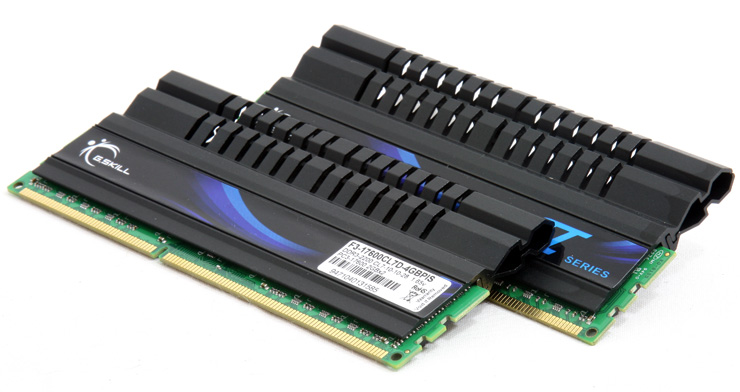
Hey everybody, with this plea I'm trying to justify the memory we'll be testing today. G.Skill recently put out a low voltage dual-channel DDR3 memory kit on the market to pair with your shiny P55 / Core i7 860/870 PC. The memory is rated at 2200 MHz and does so at a sexy CAS latency of 7 (!) (we'll explain timings and latency in this article btw).
Some Memory vendors felt the need to go really extreme, and GSkill did exactly that. 2200 MHZ at CAS 7 at low voltage (1.65v). Now if you don't know what these number mean, then surely this memory and review is not catered for you. Seriously, it's one of the few memory kits we have seen we consider to be extremely uber cool. Powered by Elpida Hyper ICs G.Skill certainly tries to make a difference.
So today we'll test this kit with 2x 2GB memory, and that is quite a challenge as we'll need to make a really good effort to get the processor at a high base clock and a motherboard that allows it. As such we take the MSI Big bang Trinergy P55 motherboard and pair it with a Core i7 870 processor which offers a memory ratio we really enjoy. Small hint, you should only use this memory with a Core i7 860 or Core i7 870 as you really need that extra multiplier to reach 2200 MHz.
Our target will be to try and achieve that 2200 MHz on the memory. Hard to accomplish yes, but let's see if we can manage this just fine.
G.Skill designed another 8GB low voltage DDR3 kit (2x 4GB) that can be set at 1600 MHz yet still run a CAS latency of 7. And that is truly interesting because the denser the ICs get, the higher latency typically gets.
G.Skill 2x4GB CL7 1600 MHz Trident DDR3 review
We feel that more memory is rather important, and in that trend memory manufacturers have started to increase the density of DIMM modules. Where 1 and 2GB DIMM modules have been the standard, we now see very good progress in 4 GB DIMM modules. Today we\'ll do things a little different, G.Skill designed a 8GB low voltage DDR3 kit (2x 4GB) that can be set at 1600 MHz yet still run a CAS latency of 7. And that is truly interesting because the denser the ICs get, the higher latency typically gets.
G.Skill Flare DDR3 2000 MHZ C7 AMD kit review
We test and review the G.Skill Flare DDR3 2000 MHZ C7 AMD kit. These kits are optimized for AMD platforms preferably with the new six-core X6 processors, and in specific some ASUS motherboards. The kit we'll be testing today obviously comes from that series and is a 2,000MHz CL7-9-7-24 1.65V 4GB (2GBx2) DDR3 kit with its latest Flare heatsinks.
G.Skill Phoenix PRO 120GB SSD review
The SSD tested today once again is the Phoenix series from G.Skill. After we tested their 100GB Phoenix SSD (which received a very positive review) G.Skill instantly requested if we would like to review the 120GB PRO model. Both drives pretty much are the same thing, same controller ... The 100GB Phoenix uses Samsung memory though but the trick is that there is 20GB extra volume space available on the new 120GB Pro (compared to the 100GB model) for nearly the same price. A new Firmware for the SandForce 1200 based controller that is inside this 120GB model simply reserves less NAND flash memory for its data-compression scheme. As a result the overall write performance could be a tiny bit slower, but only a few percent as best. It however will give you 20 GB more space to play around with at the same price. And since price per GB is everything in the land of SSDs -- this certainly is a significant for any vendor and for you as an end-user.
