Page 1

A week or four ago NVIDIA announced a new graphics card, yep the GeForce GTX 690 has surfaced. The card we test today comes from EVGA, they obviously released a SKU based on this product as well. The product tested is reference based thus the review will be very similar to the original review. However we decided to review a retail sample for the simple fact top see if anything at all would be different, and obviously to show you what you receive bundle wise.
The GTX 690, in a nutshell, NVIDIA took two of their best (Kepler GK104) GPUs, placed them onto one card, topped it off with a very nice and dandy cooler and called this symbiosis of components a single solution graphics card. Internally on that card a small PLX chip functions as a PCI Express bridge in-between the two GPUs and sure, that means SLI is in full effect. The release today is very interesting as the GTX 690 is amongst the most silent multi-GPU solutions we have ever had our hands on, the performance really is quite seriously staggering and despite all that brute force the power consumption remains very acceptable.
The end result is a beast of a graphics card that renders games atrociously fast, even with the most stringent image quality settings. Obviously the GeForce GTX 690 will break massive records in 3D performance as the performance is nearly equal to a pair of GeForce GTX 680s in SLI. The two PLX bridged Kepler GK104 GPUs provide 3072 Shader cores. They are paired with two 2GB memory clusters at 6 GBPs (4GB in total).
The GPUs on the GeForce GTX 690 have a boost clock of 1019 MHz, and that's less than 3% away from the GeForce GTX 680 at 1058 MHz, so that sounds pretty terrific. All other specs are identical; the number of shader processor cores, memory speed, and memory bandwidth per GPU are the same on both cards.
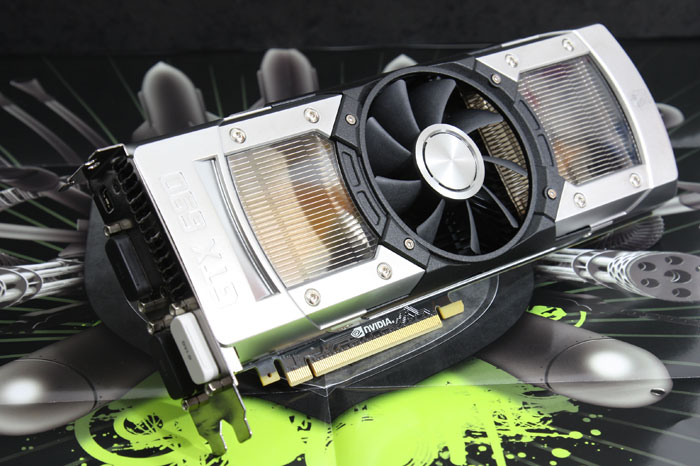
The first impressions of the board are really good, a nice sturdy design, the cooler is nearly a work of art -- we'll talk about it guided with some photos though as there is much to talk about. Looking at the printed circuit board (PCB) we spot a vigorous 10-phase digital PWM design for the cores themselves while the memory will likely receive its own 2-phase grid allocated. Two 8-pin PCI-E connectors feed the card. NVIDIA is giving the GTX 690 a maximum power target of +35%, which given the cards default power target of roughly 265W means it can be set to draw up to ~350W, and that means you'll be able to overclock nicely as well.
Display connectivity then; NVIDIA uses the same 3x DL-DVI and 1x miniDP port configuration that is used on the GTX 590. That will allow for three connected monitors over DL-DVI. Now these are just the first impressions, we are going in-depth over the next few pages of course. We do need to mention that that card is very expensive at a price of 999 USD / 949 EUR. Have a peek at the awesomeness that is the GeForce GTX 690, and then head on over to the next page where, as always, we'll go a little deeper, but not too deep. We'll look at noise levels, power consumption, heat, we'll do a nice photo-shoot and an extensive benchmark session to see where this product positions itself.
Have a peek at the EVGA GeForce GTX 690 -- next page please.