Dark Power Pro 1000 Watt PSU review
Posted by Hilbert Hagedoorn on: 07/31/2007 01:00 PM [ 0 comment(s) ]
The Test
Right, how do you test a PSU? It's difficult, to be honest. Unless you have seriously professional equipment, it's very hard to test and most of all stress a PSU. Firstly we do a quick test with this nifty new gadget I have been testing. With a power supply tester I'll quickly check if the rails are all working properly and what amount of voltage they are delivering without a PC connected to it. Let's have a look:
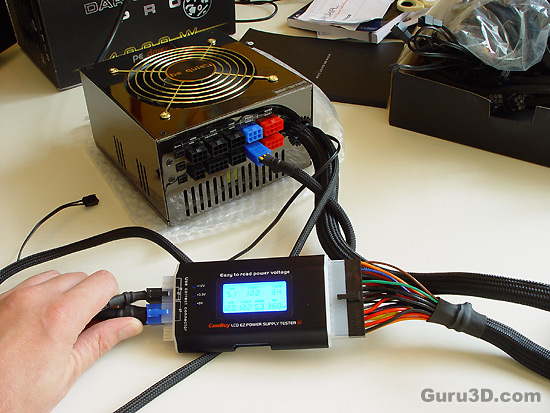
This is how that test is being done. Let me zoom in a little as the LCD screen is a little overexposed.
Okay so we can immediately see that all primary voltage rails are working properly. Voltages seem a little on the high side, yet fall well within ATX specifications. So this is looking good. This however is not an objective enough tool to measure voltage at all.
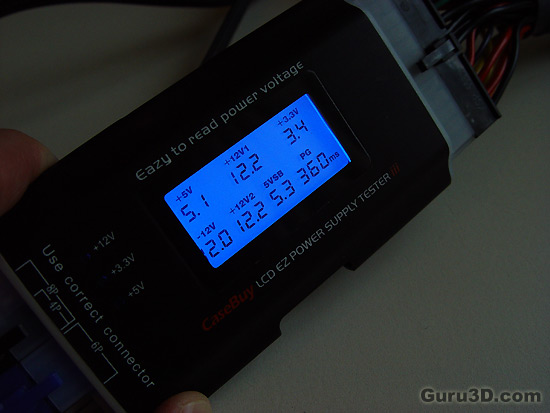
This device delivers FAR from precise measurements though. For those that are wondering what the PG delay being displayed on the screen is, here we go: Power Good (PG) Delay and Off Delay: It takes a power supply at least 100ms to completely power up before it can offer the proper DC voltages to the computer. The computer will not attempt to turn on until the power supply is finished powering up and sends a Power Good (PG) signal to the motherboard via a PG terminal. On power up the Power Good (PG) terminal is polled for a brief period before the PC turns on to check the status of the power supply. Only after the +5V and +3.3V rails are above threshold does the PG signal go "high." The PG signal stays on until the PC is ready to power off. The period of delay between switching on the PS and the actual application of power is the PG delay. Typical values are 100-350ms. The PG delay of the power supply should roughly match the PG delay specification of the motherboard or power on problems may occur.
So this is within specifications. Let's do a real-world test.
So a couple of weeks ago I had a call from Miss D. at Listan, their rock solid BeQuiet series is to be updated to a new revision. And at that very moment I was like ..hmm what on earth could they improve ? Well, before we get into that .. let me just say .. they did. On the next pages we'll show you a full-fetched review on their all new BeQuiet Dark Power Pro "First Class" edition of power supplies. A PSU series that is quite efficient, stable and so darn quiet .. that I measured over and over again.
Dark Power Pro 1000 Watt PSU review
The Dark Power Pro is an 1000 Watt PSU which places it in the high-end segment. A PSU which (although not certified) is 100% ready for SLI ready and Crossfire certified even Quad; as it has four dedicated 12 volts PCI-Express connectors which combined can carry a total of 75 AMPs, and according to the box, the PSU 12 volts rails may peak to 20 AMPs per 12V rail.
BeQuiet Dark Power PRO 850 Watt PSU review
The last time I received a power supply from them I received an email back from a friend working in the graphics card industry. He said "Hilbert, I just bought one of these and you were 100% right. I'm really glad I bought one." So for Listan it's difficult to improve an already great product I figured. Hmm, nope! In the ever-growing demand of power consumption they have yet again released an affordable power supply, this time with a 850 Watt rating yet for a price that's stunning. Next to that it's modular, has high energy efficiency, is quite silent and will fit in any case due to it's small size opposed to the Kilowatt PSU's we recently have seen.
BeQuiet! Dark Power Pro 600 Watt PSU
Sound levels coming from your PSU. The high rated PSU's typically have two fans and a lot of manufacturers did not pay attention to all the noise a PC makes these days. So the third factor was utilizing silent high-performance fans preferably with smart-fan technology (variably fan speeds based on heat). And with these factors in mind we land at a product line called BeQuiet! As the name suggests we do not expect this product to make heaps of sound. The product is named mysteriously the "Dark power Pro". We'll be testing the 600 Watt model to see if it can manage a high-end system with NVIDIA SLI technology.
