Page 6 -- Benchmarks - RMAA & RM3D
RMAA & RM3D
As always, a new review, a new version of RMAA, this time to 6.1.0. Asus sent me their RMAA test guide for the D2X which has some very interesting directions. The D2X has a special mode called ALT, basically a high-quality loopback recording mode, that they would prefer me to use with RMAA. Asus also includes a copy of RMAA in the software bundle, too, which is a little odd. Normally I use a cable and record line-out to line-in. Using an external cable ensures that what gets measured will generally be what you hear. But using the ALT mode produces spectacular results, but it isnt exactly a truthful mode because it doesnt actually allow RMAA to measure sound thats coming out of the jacks.
Its not clear how far down the audio chain the ALT works, is it inside the APU, after the DAC, or after the op-amps?
In any event, let me show you what the D2X can do.
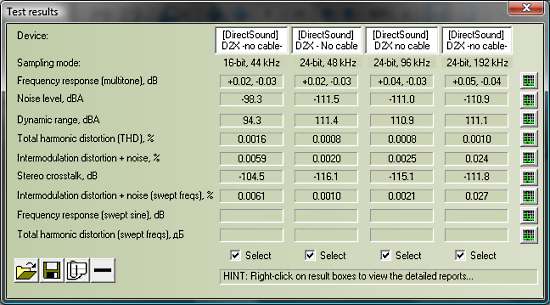
Its just so pretty. The D2X in the ALT mode measures extremely well. Each measurement, THD, Noise, IMD, are all the best weve ever seen with RMAA. This alone is a bit of a red flag since I firmly believe nothing can measure this well. Then, of course, you realize youre in the ALT mode, and thats partially what its there for.
Unfortunately, using the loopback method with a cable produces the same damn results, with a single casualty: stereo crosstalk. I think it means I need a better cable.
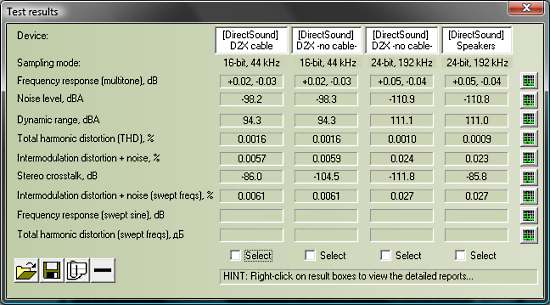
The intermodulation distortion on the 24-bit/192 KHz mode is worrysome, but we'll investigate this further down.
No matter how you slice it, though, the D2X is scary good. Let's compare the D2X to sound cards of times passed.
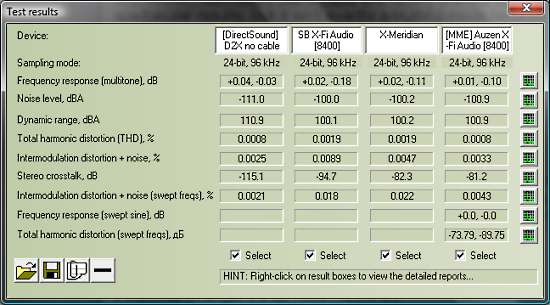
This isn't an oranges to oranges comparison here, because the results are gathered over the years of testing with different versions of RMAA. But one thing is clear, the D2X performs pretty well innit? The Auzen X-Prelude uses similar quality DAC's and shows in the THD and IMD tests.
But let's take a look at RMAA graphs for 24-bit/192 KHz mode. The sweet spot for the D2X, at least in terms of measured performance, is the 24-bit/48 KHz resolution. As the resolution/bit-depth goes up, the measured performance appears to go down, and we notice some high-frequency rolloff around 50 KHz. Take a look:
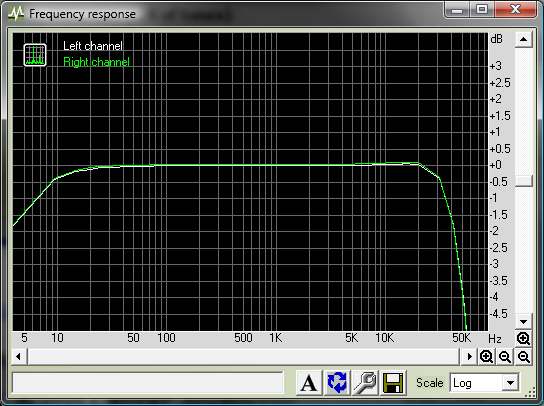
You would see this kind of frequency response of a 96 KHz card, and not one capable of 192 KHz. Using the Nyquist frequency for 192 KHz sampling, rolloff should start around 96 KHz. Likewise a 96 KHz sampling frequency has a Nyquist frequency of 48 KHz (1/2 the sampling rate), like what we see above. This is clearly something that is in the card, as settings were double and triple checked, even the seperate record and playback sample rates in RMAA 6.1.0. It's stuck there.
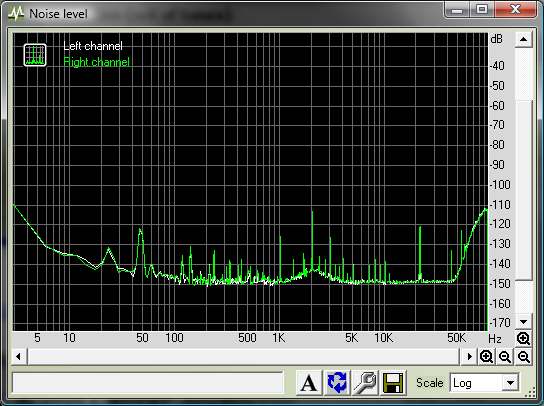
Discounting the rolloff of frequencies above 50 KHz, just look at those numbers! Some spikes up to -110 dB, but a floor of around -150 dB. This is just awesome performance for any kind of card, professional or enthusiast.
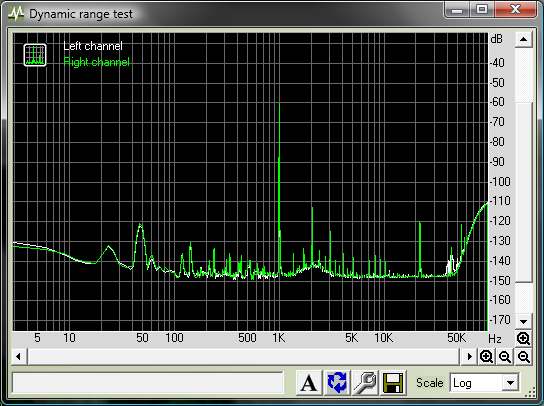
Dynamic range would be important if music actually made use of it. These days, even for some new classical releases, dynamic range is compressed to make a song sound as loud as possible. I've been on this soapbox before, and I'm on it again, but I wish record companies would come back to their senses with music and stop the compression. It's also why I don't review with music newer than early 90's. It all just sucks after that! Now then, if there were recordings that could swing 100dB's between loud and soft, the D2X could handle it no problem.
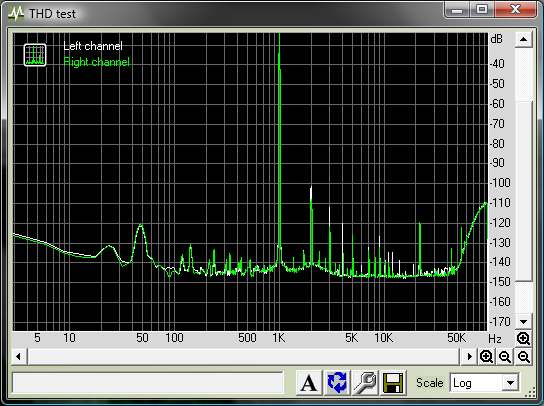
Total Harmonic Distortion measures how accurately the system can play back a single frequency, in this case a 1000 Hz tone. Basically, this thing is frighteningly clean, with most of the overtones at well under -110dB. This means that anything that gets played through the D2X will be very crisp and very clear.
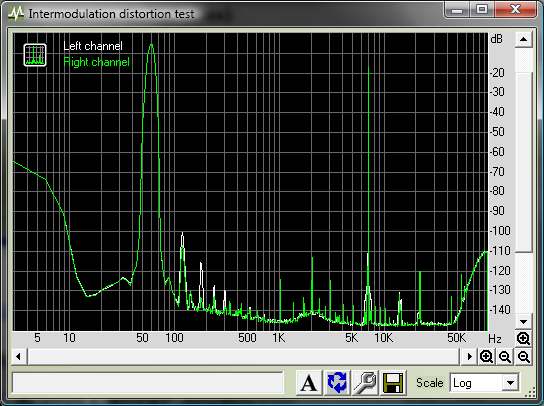
Intermodulation distortion is produced when two or more frequencies added together (like real music is) introduce overtones not related any tones being played. This is sometimes called wolf-tones, or beat patterns. These are extremely bad for audio gear to introduce, especially if the piece of music actually uses intermodulation as a sound effect. Again, the D2X is eye-poppingly good.
Without a doubt, the D2X produces the best RMAA numbers we've ever seen, and it jives with what I found in the listening tests.
Let's take a brief look at RM3D 2.3 for some extra information as it relates to DirectSound hardware features.
Device: Speakers (ASUS Xonar D2X Audio Device)
Features:
DirectSound 2D Hardware: Yes
DirectSound 3D Hardware: Yes
EAX 1.0: Available
EAX 2.0: Available
EAX 3.0: Available
EAX 4.0: Available
EAX 5.0: AvailableRates:
dwMinSecondarySampleRate 100
dwMaxSecondarySampleRate 192000Free buffers stats:
dwFreeHw3DAllBuffers 128
dwFreeHw3DStaticBuffers 128
dwFreeHw3DStreamingBuffers 128
dwFreeHwMixingAllBuffers 128
dwFreeHwMixingStaticBuffers 128
dwFreeHwMixingStreamingBuffers 128Max buffers stats:
dwMaxHwMixingAllBuffers 129
dwMaxHwMixingStaticBuffers 129
dwMaxHwMixingStreamingBuffers 129
dwMaxHw3DAllBuffers 129
dwMaxHw3DStaticBuffers 129
dwMaxHw3DStreamingBuffers 129Misc stats:
dwFreeHwMemBytes 0
dwTotalHwMemBytes 0
dwMaxContigFreeHwMemBytes 0
dwUnlockTransferRateHwBuffers 0
dwPlayCpuOverheadSwBuffers 0Device: ASUS Xonar D2X Audio Device
OpenAL 1.1Features:
Hardware 2D Buffers 62
Hardware 3D Buffers 62
EAX 1.0: Available
EAX 2.0: Available
EAX 3.0: Available
EAX 4.0: Available
EAX 5.0: Available
X-RAM: N/A
Here we can clearly see the effects of the DS3D GX in action, reporting EAX all the way up to 5.0. Functionally, the algorithm is still EAX 2.0 in terms of effects and abilities, but it allows games to detect the Xonar D2X and run with EAX 5.0 settings. We also see the D2X supporting 128 buffers which is the highest currently available in any sound card.
