Guru3D.com
  • HOME
  • NEWS
    • Channels
    • Archive
    • Search
    • Submit
  • DOWNLOADS
    • New Downloads
    • Categories
    • Archive
    • Search
    • Submit
  • GAME REVIEWS
  • ARTICLES
    • Editorials
    • Guru3D VGA Charts
    • Rig of the Month
    • Join ROTM
    • PC Buyers Guide
    • Dated content
    • More Categories
  • HARDWARE REVIEWS
    • Videocards
    • Processors
    • Audio
    • Motherboards
    • Memory and Flash
    • SSD Storage
    • Chassis
    • Power Supply
    • Laptop and Mobile
    • Smartphone
    • Networking
    • Keyboard Mouse
    • Cooling
    • Knowledgebase
    • Search articles
    • More Categories
  • FORUMS
  • SEARCH
    • Search Articles
    • Search News
    • Search Files
  • NEWSLETTER
  • CONTACT

New Reviews
ASUS Maximus VI Extreme Z87 motherboard review
ASUS GeForce GTX 780 DirectCU II OC review
Fractal Design Arc Midi R2 review
Corsair Vengeance K70 review
MSI GeForce GTX 770 Lightning review
EVGA GeForce GTX 770 SC review
Plextor M5M 256GB mSATA SSD review
AMD A10 6800K review
SanDisk Extreme II 120 - 240 and 480 GB SSD review
ASUS Sabertooth Z87 motherboard review

New Downloads
Media Player Classic Home Cinema v1.6.8 Download
Sandra 2013 SP4 19.50 download
MSI Afterburner 3.0.0 Beta 10 Download
AMD Catalyst 13.6 BETA 2 Download
CPU-Z 1.6.4
AIDA64 Download version 3.00
AMD Catalyst 13.6 BETA Download
PrecisionX Download Version 4.2.0
GeForce 320.18 WHQL Driver Download
AMD Catalyst Application Profile Download 13.5 CAP1


New Forum Topics
by: Stone Gargoyle Xbox World reveals Next Gen Xbox?by: StewieTech I´m starting to walk a dark path because of guru3d.by: Stone Gargoyle Battlefield 4 in October 2013?by: BlackBriar 128gb SSD for OS: Crucial M4 vs Samsung 840 Pro?by: ThinkAgain101 Next-Genby: sajibjoarder safe voltage for i7 3930kby: Hilbert Hagedoorn ASUS starts selling Republic of Gamers G750 Laptopby: harkinsteven Field of Tifton 85 Grass Suddenly Produces Cyanide; Kills Cattleby: Enmity 27" pls, 29" ips or 120hz 1080p?by: Glidefan the "i'm proud of this picture i took" thread #3


Online Users
There are currently 2542 user(s) online:
501105, Dillinger, Geralt, Google, HonoredShadow, Live Search, MasterBash, MSN, Neo Cyrus, pbvider, slow_poke, Starfighter2, sverek, Yahoo


Guru3D.com » Review » ASUS Radeon HD 7970 DirectCU II review » Page 2

ASUS Radeon HD 7970 DirectCU II review - Southern Islands and Tech

Posted by Hilbert Hagedoorn on: 03/13/2012 02:00 PM [ 0 comment(s) ]

Tweet


Southern Islands

So over the past few months you have been hearing about several codenames and that can be a little confusing. It's simple really, in the market we have entry level, mainstream and high-end products. When you notice 'Cape Verde' that's entry level, the 7700 series that was just released. Pitcairn will be the codename the mainstream products (7800) will hide under, and finally Tahiti is the codename for the GPUs used on AMD's most high-end graphics cards.

  • Entry level = Cape Verde = Radeon HD 7700 series
  • Mainstream level = Pitcairn = Radeon HD 7800 series
  • High-end level = Tahiti = Radeon HD 7900 series

The entire segment from top to bottom will be released in Q1 2012.

Technology

With an R7970 in da house we'll focus on the 7900 series today of course, but it is important to understand that there are significant changes in this family of GPUs. The GPU architecture was overhauled, AMD moved towards a 28nm process technology, the new cards are PCIe gen 3 compatible and there have been significant changes on power consumption. We'll address all the features separately of course.

With the launch of the Radeon HD 7000 series you will also see Eyefinity updated towards version 2.0 DDM, audio is now fully supported (you hear audio on the actual monitor it's played off), a new 5x1 landscape mode is introduced, and you may now create custom multi-monitor resolutions.

Let's break things down.

Radeon HD 7970

Right, we start off with the GPU overview (we'll discuss architecture later). AMD now bakes GPUs on the all new 28nm node, in very simple wording that means they can put more transistors on a smaller area. The Tahiti core has a stunning 4.3 Billion transistors, 4,312,711,873 to be precise.

The internal architecture has changed,  we'll talk a little deeper about that in a minute. But as a result the R7970 is packed with 2048 shader processors harbored in Compute Units segments (32 of them).
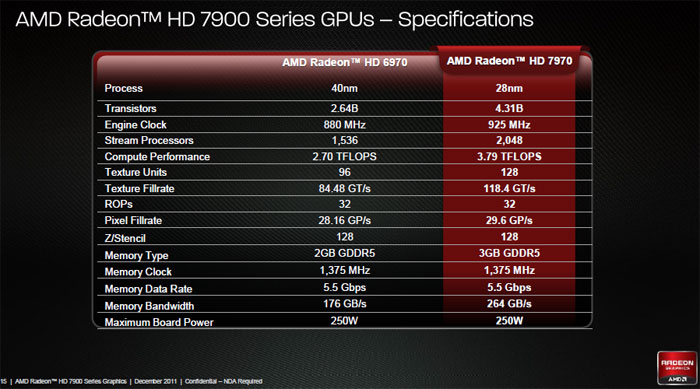
Memory volume wise the rumors where right, the card will pack a massive 3 Gigabyte of DDR5 memory. This is not done for bragging rights, but AMD simply takes Eyefinity and multiple monitor usage very seriously, it is there where the extra memory makes a lot of sense. The memory bus has been increased from 256-bit towards 384-bit as well.

Packing so many transistors on a product is staggering, but if you can't apply a fast enough clock frequency it will become a problem. Well, that's not an issue for AMD either, the R7970 is clocked at a very fast 925 MHz with room to tweak towards a full GHz or even higher. That 384-bit memory is clocked at impressive speeds as well,  5.5 Gbps that's bandwidth for up-to 264 GB/sec (!).
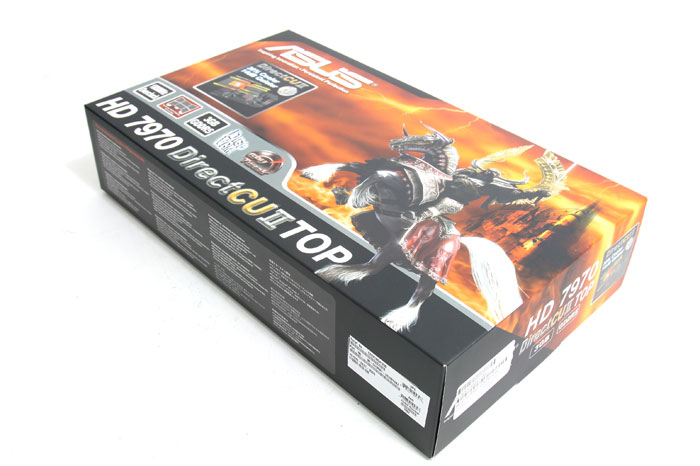
 

ASUS R7970 Direct CUII


24 pages 1 2 3 4 next »


Related Articles
ASUS Radeon HD 7970 ROG MATRIX Platinum review
We review the ASUS Radeon HD 7970 ROG MATRIX PLATINUM graphics card. Designed to be one of the most tweak-able and desirable graphics cards.

ASUS Radeon HD 7970 DirectCU II review
We review the ASUS Radeon HD 7970 DirectCU II. A factory overclocked three slot wide beast with massive cooling capacity. The completely customized card comes with voltage measurement points, a 12-phase VRM circuitry with supper alloy caps and chokes as well as a special SAP capacitor added to maximize overclocking headroom, according to ASUS.

ASUS Radeon HD 7970 Crossfire review
We review the Radeon HD 7970 in Crossfire, a second board partner card has arrived. Let's take it to the next level -- multi-GPU gaming in Crossfire mode.

ASUS Radeon HD 6770 DirectCU Silent review
Today we look at the ASUS Radeon HD 6770 DirectCU Silent edition. An entry level product series for gamers based on a juniper graphics core that still can flex its muscle. The x-factor for this particular product however is that its completely passively cooled, what should be a relatively small card .. ends up like the USS enterprise in terms of size and design.

Follow Guru3D on Google+ - Facebook - YouTube - Twitter © 2013